Shira Route
Kilimanjaro's original western plateau trek — drive to the Shira Plateau, cross vast moorland, conquer the Barranco Wall, and summit via Barafu. One of the mountain's quietest and most dramatic routes.
The Original Western Plateau
The Shira Route is Kilimanjaro's original western approach — the predecessor to the now more popular Lemosho Route, and one of the least-travelled trails on the mountain. Where the Lemosho begins in the dense rainforest at Londorossi Gate, the Shira takes a different path: after registration at Londorossi, you continue driving through the national park all the way to Morum Barrier (also called Shira Gate) at 3,414m. The rainforest is left behind through the windscreen. You step out onto the Shira Plateau already at significant altitude, with the full sweep of the moorland and Kibo's dome ahead of you from the very first steps.
This is both the Shira Route's defining character and its primary challenge. The plateau is extraordinary — ancient, volcanic, vast, and beautiful — but arriving here so quickly without the gradual rainforest acclimatization means your body is immediately exposed to significant altitude. Days 1 and 2 are spent crossing this magnificent plateau past the dramatic spires of Shira Cathedral (3,750m) to Shira 2 Camp (3,840m), where the route merges with the Lemosho and soon after with the Machame Route. From Day 3 onward, the routes are identical: the powerful "climb high, sleep low" day to Lava Tower (4,630m) and down to Barranco, the thrilling Barranco Wall scramble, the Southern Circuit traverse beneath the southern glaciers, Barafu Camp, and the midnight summit push to Uhuru Peak (5,895m). Descent is via the Mweka Route.
The reward for those who are prepared: two days of almost complete solitude on one of Kilimanjaro's most scenic plateaus, followed by the full drama of the southern circuit. The Shira Route suits experienced trekkers who want a quiet, dramatic western approach and are willing to manage the higher-altitude start carefully. The 7-day option — with its Karanga Camp overnight — is strongly recommended for everyone.
Is the Shira Route Right for You?
- Extraordinary Shira Plateau scenery — vast ancient moorland few trekkers experience
- Very low crowd levels — almost no other trekkers on Days 1–2
- Shira Cathedral — dramatic volcanic spires unique to this section of the mountain
- Powerful acclimatization on Day 3 — Lava Tower (4,630m) "climb high, sleep low" cycle
- Full Southern Circuit experience — Barranco Wall, southern glaciers, Karanga Valley
- Unique "drive to trailhead" start — dramatic arrival directly onto the plateau
- Second shortest route after Umbwe — efficient for time-limited climbers with experience
- High starting altitude (3,414m) — no rainforest acclimatization buffer; risk of AMS from Day 1
- Lower success rates than Lemosho — same plateau, less acclimatization time
- Misses Kilimanjaro's rainforest — one of the mountain's most beautiful ecological zones
- Not suitable for first-time high-altitude trekkers without pre-acclimatization
- Plateau very exposed — strong winds and cold from the very first day
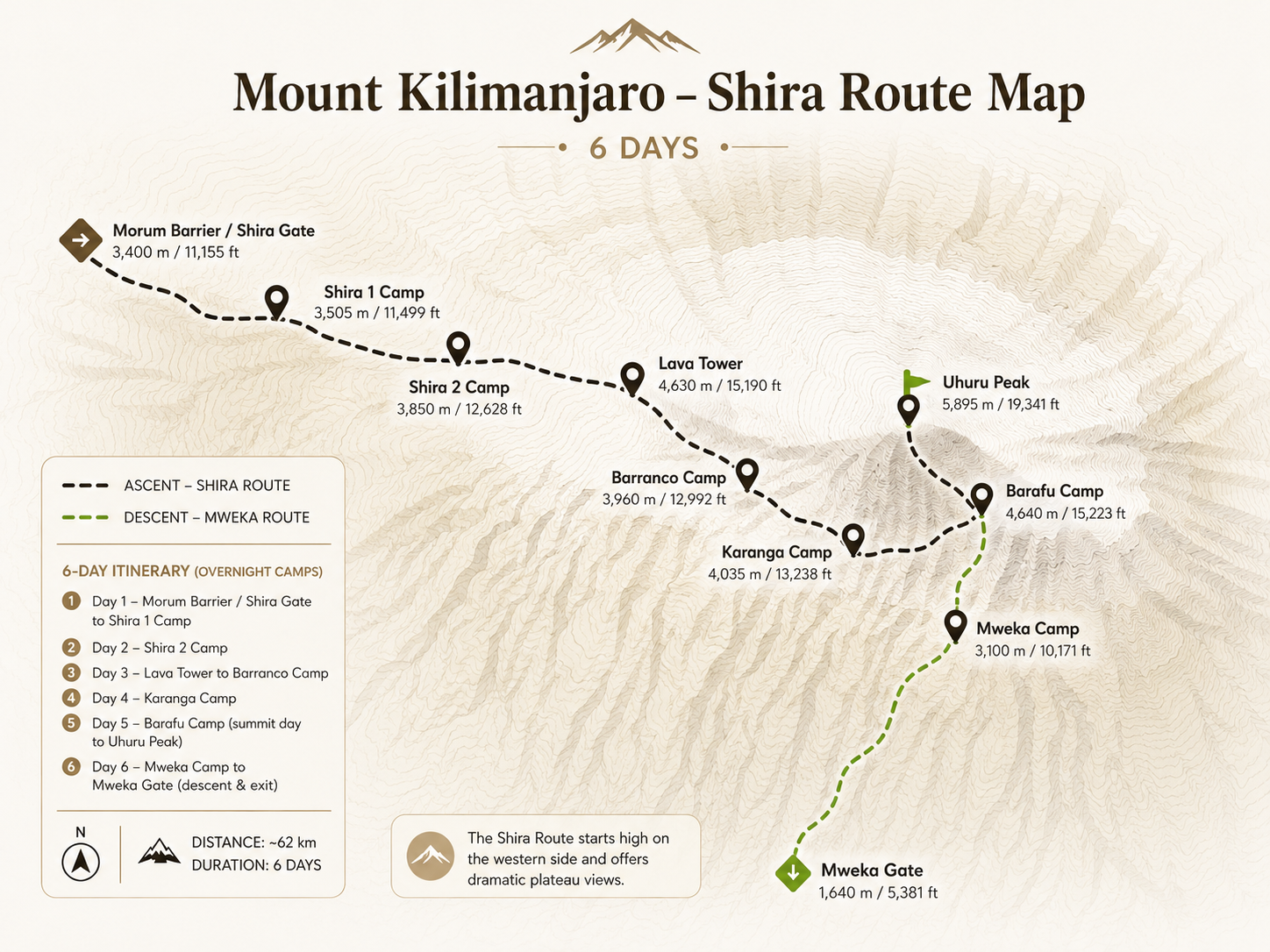
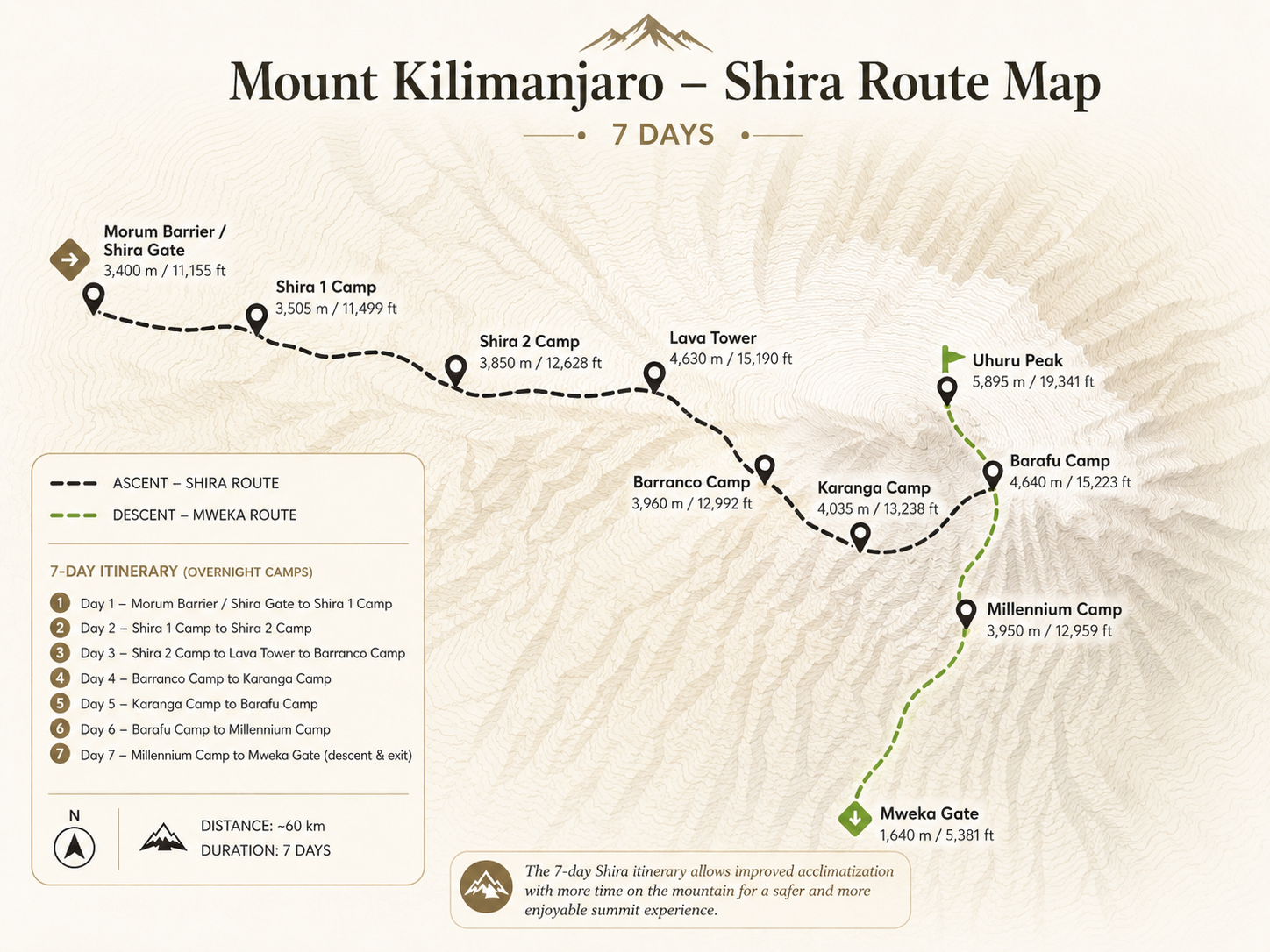
Shira Route on the Map
Visual Guide
Elevation Profile
Route Itinerary
Your Shira Route begins differently from almost every other Kilimanjaro climb: you don't walk to the trailhead — you drive there. After registration formalities at Londorossi Gate, the 4x4 vehicle continues through the national park on a steep, sometimes rough track, climbing through the forest zone without stopping, past the Morum Barrier at 3,414m where you park and begin on foot. For many climbers, stepping out of the vehicle here — already at over 3,400 metres, with the vast Shira Plateau spreading out ahead and the summit of Kibo visible above — is one of Kilimanjaro's most dramatic first impressions.
The walk itself on Day 1 is relatively short and gentle — a 4–5km traverse through heath and moorland on the western plateau, with wide open views in every direction. Giant heathers and volcanic rock formations line the path. The altitude is immediately noticeable: the air is thin, the sun is strong, and the wind can be cold. After just 2–3 hours you arrive at Shira 1 Camp (also known as Simba Camp) at 3,610m — your first night on the mountain, already higher than most routes reach on Day 3. Hydrate aggressively, eat a full dinner, and rest carefully. The altitude is real from the very first evening.
Today you cross the heart of the Shira Plateau — one of Kilimanjaro's most ancient and dramatic landscapes. The plateau was once a third volcanic peak, collapsing inward hundreds of thousands of years ago into the vast open caldera you now traverse. The trail winds east across volcanic rock, lava ridges, and open moorland with increasingly clear views of Kibo's summit looming to the east. The sky is enormous here — there is almost no vegetation taller than your knee.
The centrepiece of the day is Shira Cathedral (3,750m) — a magnificent cluster of volcanic rock spires and buttresses rising from the plateau floor, surrounded by pinnacles of ancient lava. It is one of the three peaks of Kilimanjaro and a world of its own to explore. From the Cathedral, the trail continues east to Shira 2 Camp (3,840m) — where the Lemosho Route trekkers arrive on their Day 3. For the first time on the Shira Route, you have company in camp. Guides run a thorough altitude check for everyone. Afternoon mist often rolls in on the plateau — layer up after dinner and sleep as early as possible.
This is the defining acclimatization day of the Shira Route — a day that works powerfully in your favour if you let it. The trail climbs steadily east from Shira 2, leaving the plateau behind and entering the high alpine zone beneath the Western Breach glaciers. A dramatic waypoint early in the day is the Shark's Tooth, a striking volcanic spire. The path climbs through sparse high-altitude vegetation to Lava Tower (4,630m) — an enormous volcanic plug rising from the scree, and one of Kilimanjaro's most iconic landmarks.
Lunch at Lava Tower. At 4,630m, your body is experiencing its highest altitude yet — and this is deliberate. Near the Tower, the Machame Route trekkers merge from the south, and the trail becomes shared from here onward. Then — instead of pushing higher — the trail turns south and descends steeply and beautifully through the extraordinary Senecio Forest: giant groundsels rising prehistoric from the moorland in dense clusters. The descent of nearly 700 metres to Barranco Camp (3,950m) is pure altitude physiology in action. "Climb high, sleep low." Your red blood cell production is working hard. Tonight, your body is more acclimatized than it would have been without this day. Barranco Camp sits dramatically beneath the Barranco Wall.
On the 6-day route, today is the mountain's longest and most demanding day. You begin with the Barranco Wall — Kilimanjaro's most famous non-summit obstacle. The 257-metre volcanic cliff is a non-technical scramble but looks nearly vertical from below. Hands and feet work together over solid volcanic rock holds, with your guides above to assist at exposed sections. One to two hours to ascend, extraordinary views from the top. The effort is real, and the reward — the entire southern ice field blazing white above, Tanzania's plains dropping away below — is extraordinary.
On the 6-day route, there is no overnight stop at Karanga. After the Wall, you traverse east across the Karanga Valley — crossing the Karanga stream beneath the hanging glaciers of the southern ice field — and keep climbing. The trail is relentless through the high alpine desert. Barafu Camp (4,600m) comes into view in the afternoon, perched on a windswept ridge. You arrive tired. Your guides run comprehensive summit briefings: timing, pacing, gear. Eat everything you can, drink constantly, and sleep as early as possible. The alarm is set for midnight.
Midnight. Your guide wakes you in darkness and cold. You dress in every layer — thermal base, fleece, insulated jacket, down parka, balaclava, heavy gloves — and step outside into a sky blazing with stars at 4,600m. Your headlamp joins dozens of others already moving up the slope above. "Pole pole." Step by step, breath by deliberate breath. The scree switchbacks are relentless. The cold is profound. But your guide is steady beside you, adjusting pace, reading your body, keeping you moving.
After 5–7 hours of darkness and effort, you crest the crater rim at Stella Point (5,756m). The sunrise over Mawenzi — pink, gold, and infinite — greets you at the top of Africa's sky. The final push: 30 minutes along the crater rim past towering glaciers to Uhuru Peak (5,895m). The summit sign. The tears. The silence. Everything you carried through six hard days brought you here. The descent via Mweka is long and relentless — past Barafu for lunch, then through the alpine desert until the forest returns at Mweka Camp (3,100m). You arrive late afternoon, completely spent, completely victorious.
Your final morning. The forest zone welcomes you back with warmth, birdsong, and rich air. The descent from Mweka Camp (3,100m) is steep and sometimes muddy but the rich oxygen at lower altitude reinvigorates every step. After 3–5 hours, Mweka Gate (1,640m). Your guides and porters gather for the celebration ceremony — traditional songs, dancing, handshakes. Your official Kilimanjaro Summit Certificate is placed in your hands. The drive back to Moshi is quiet, reflective, and deeply satisfying. You climbed Kilimanjaro's original western route and reached Africa's highest point.
Registration at Londorossi Gate, then the journey continues by vehicle through the national park, climbing through the forest zone on a rough track to Morum Barrier (3,414m). Stepping out here onto the Shira Plateau is one of Kilimanjaro's most dramatic starting moments: the entire western flank of the mountain stretches out ahead, and Kibo's summit looms immediately visible to the east. No other Kilimanjaro route delivers this view on the first day — or starts at this altitude. Your Haven Trails team completes final equipment checks and you set off into the heath and moorland.
Day 1 on the 7-day option is identical to the 6-day, but you carry a different mental posture — you know you have an extra day built into your schedule for proper acclimatization, which eases the psychological pressure that altitude can create. The walk is short and gentle: a 4–5km plateau traverse to Shira 1 Camp (3,610m). Afternoon wind picks up as the sun drops. Layer up early. Drink constantly. Early dinner and early to bed — your body has arrived at altitude without the gradual approach of the forest routes, and rest is its most urgent need.
Today you cross the ancient heart of the Shira Plateau — one of Kilimanjaro's most primordial and photogenic environments. The plateau is a high-altitude volcanic caldera, collapsed hundreds of thousands of years ago. From horizon to horizon it stretches in every direction: volcanic rock ridges, open moorland, lava formations, and the silence of genuine wilderness. Kibo's massive dome draws ever closer to the east as you walk. The air is noticeably thin and the sun intense at this altitude — sunscreen and sunglasses are essential.
Shira Cathedral (3,750m) is the day's centrepiece — a cluster of ancient volcanic spires and buttresses rising dramatically from the plateau floor, their weathered rock columns like the ruins of some vast natural fortress. The views from the base of the Cathedral across the plateau and toward Kibo are extraordinary. From the Cathedral, the trail continues to Shira 2 Camp (3,840m), where Lemosho Route trekkers arrive and join you for the first time. After two days of near-solitude on the plateau, the camp suddenly feels lively. Pulse oximetry checks by your guides. Warm layers on after sunset. Tomorrow's Lava Tower day is the most important acclimatization event of the entire trek.
The most important acclimatization day of the entire Shira Route. The trail climbs steadily east from Shira 2 through the high alpine zone, past the volcanic Shark's Tooth formation, toward the Western Breach of the mountain. The glaciers of the Northern Ice Field become visible above — dramatic, ancient, and retreating. You climb to Lava Tower (4,630m) — an enormous free-standing volcanic plug at nearly 4,700m, one of Kilimanjaro's most dramatic landmarks. Lunch here. Your body is experiencing its highest altitude yet.
The Machame Route merges near Lava Tower — the camp and trail become busier from here. Then the trail turns south and descends powerfully through the Senecio Forest: giant groundsels (tree senecios) rising from the moorland in prehistoric clusters, their enormous rosettes pointing skyward in an alien landscape found almost nowhere else on Earth. The descent of nearly 700m to Barranco Camp (3,950m) completes the "climb high, sleep low" cycle — one of altitude medicine's most powerful tools. Your blood is already making more red blood cells. Barranco Camp, set directly beneath the Barranco Wall, is dramatic and beautiful. Rest well — you earned it.
Today opens with the Barranco Wall — one of the most exhilarating and iconic moments on any Kilimanjaro trek. The 257-metre volcanic cliff looks impossibly steep from Barranco Camp, but the ascent follows a brilliant natural route using solid volcanic rock holds in a non-technical scramble requiring hands and feet. Your guides position themselves above to assist at the most exposed sections. The effort takes 1–2 hours. The views from the top are breathtaking: the entire southern ice field glowing above, the Barranco Valley far below, Tanzania's plains stretching to infinity.
From the top of the Wall, the trail traverses east across a series of ridges and valleys along the Southern Circuit, beneath the spectacular Heim, Kersten, and Decken Glaciers of Kilimanjaro's southern ice field. These glaciers are visible at extraordinary proximity — close enough to feel the cold radiating from the ice above you. The Karanga Valley ravine is crossed before a final short climb to Karanga Camp (4,000m) — a smaller, more intimate camp than Barranco, set directly beneath the glaciers. This overnight is the 7-day route's critical acclimatization advantage: one more night at a moderate altitude before the final push to Barafu. Your body is adapting beautifully. Tomorrow is the last step before summit night.
A short, focused day. The trail climbs from Karanga through the high alpine desert — bare volcanic scree, increasing thin air, wide views. You pass the junction with the Mweka descent trail before the final climb to Barafu Camp (4,600m), arriving in the early afternoon to maximise rest time before the midnight start. Barafu is stark and windswept — "ice" in Swahili, earned by the sub-zero nights that descend here quickly after dark.
Your guides run full summit briefings: exact timing, pacing strategy, what to expect at each altitude band, hydration and nutrition during the push, and emergency protocols. Pack your summit layers in order — thermal base first, summit shell last, gloves and balaclava immediately accessible. Eat a full meal despite the altitude suppressing your appetite. Set two alarms and commit to sleeping as early as possible. In a few hours, the adventure of a lifetime begins on the dark slopes above.
Midnight. The alarm. The cold. You rise from your sleeping bag and dress methodically — every layer going on in the right sequence — and step outside into a sky of impossible stars at 4,600m. Your headlamp finds the first of thousands of steps upward. Above you in the darkness, somewhere unreachably far, Uhuru Peak waits. Your guide sets the pace — deliberately, painfully slow. "Pole pole." One step. One breath.
The scree switchbacks on the southern slope climb for hour after relentless hour. The cold deepens as altitude increases. Your guide checks you regularly — hydration, breathing, fingers and toes. You keep moving. After 5–7 hours in the darkness, the crater rim at Stella Point (5,756m) appears against the sky just as the first light of dawn blazes orange and pink over Mawenzi Peak to the east. The sunrise at the top of Africa is a sight that changes people permanently. Then the final 30 minutes along the crater rim — past the vast remains of Kilimanjaro's ancient glaciers — to Uhuru Peak (5,895m). Africa's highest point. The summit sign. Everything you have worked for, for days and months, arrives here. This moment is yours forever.
The descent via Mweka begins immediately after. Long and relentless — Barafu for lunch, then through the alpine desert until the forest returns and the air grows warm and rich. Mweka Camp (3,100m) greets you in the late afternoon. Sleep arrives before dark.
Your final morning on Kilimanjaro. Every muscle aches, every step is downward, and the air grows richer with every metre of descent. The forest zone closes around you — warm, birdsong, and the smell of earth after days on bare volcanic rock and ice. After 3–5 hours, Mweka Gate (1,640m). Your guides and porters gather for the ceremony: songs, dancing, proud handshakes, laughter. Your official Kilimanjaro Summit Certificate — gold for those who stood at Uhuru Peak — is presented.
The drive back to Moshi is quiet and warm and carries the complete satisfaction of someone who has done something genuinely significant. You climbed Kilimanjaro's original western route — the route that preceded the Lemosho, that gave the Shira Plateau its fame, that starts at altitude most climbers only reach on Day 3. And you stood at the roof of Africa. The mountain is unchanged. You are not.
Overnight Stops
| Camp | Altitude | Zone | Night | Notes |
|---|---|---|---|---|
| Shira 1 Camp (Simba Camp) | 3,610m | Heath / Plateau | Night 1 (both) | Reached after vehicle drive to Morum Barrier; plateau entry; Kibo visible immediately; altitude from Day 1 |
| Shira 2 Camp | 3,840m | Moorland / Plateau | Night 2 (both) | After Shira Cathedral; Lemosho Route joins here; plateau crossing complete |
| Barranco Camp | 3,950m | Alpine / Valley | Night 3 (both) | After Lava Tower (4,630m) "climb high, sleep low" day; Machame Route merges; beneath Barranco Wall & southern glaciers |
| Karanga Camp | 4,000m | Alpine Desert | Night 4 (7-day ✓) · Skipped on 6-day | After Barranco Wall; beneath southern glaciers; critical acclimatization night; last water point before Barafu |
| Barafu Camp | 4,600m | Arctic / Alpine Desert | Night 4 (6-day) · Night 5 (7-day) | Summit base camp; all southern routes converge; most exposed camp; midnight departure |
| Uhuru Peak ★ | 5,895m | Summit / Arctic | — | Via Stella Point (5,756m); southern scree ascent; Africa's highest point |
| Mweka Camp | 3,100m | Upper Forest | Night 5 (6-day) · Night 6 (7-day) | Post-summit descent camp; forest returns; last night on mountain; descent via Mweka route |
| Mweka Gate (exit) | 1,640m | Forest | — | Day 6 (6-day) / Day 7 (7-day); summit certificate; crew celebration; transfer to Moshi |