
Rongai Маршрута
The only northern approach. A peaceful, gradual ascent near the Kenya border with wildlife, dramatic Mawenzi views and very low trail traffic.
The Northern Пристап
The Rongai Route is Kilimanjaro's only trail that approaches the summit from the north, beginning near the Kenya border at Nale Moru village (1,950m). This gives it a character entirely different from every other route. Quieter, wilder and with a distinctly remote feel from the very first steps. On the early days, you may share the trail with no one. Looking north from the upper camps, the vast plains of Amboseli and Tsavo National Parks spread out beneath you into Kenya, where herds of elephant and giraffe sometimes roam.
The Rongai Route offers one of Kilimanjaro's most gradual ascent profiles. Ideal for trekkers who want a steady, manageable climb without steep scrambles or dramatic day-to-day altitude swings. It passes through all of Kilimanjaro's ecological zones: pine forest, rainforest, heather and moorland, alpine desert and the final glacial arctic summit zone. Close to Mawenzi Peak, arguably Kilimanjaro's most dramatic secondary peak, the trail delivers spectacular jagged scenery before traversing the vast Saddle to Kibo Hut.
Клучен детал што ја прави Rongai Route уникатна: не се враќате по истиот пат. Се искачувате по северната патека, а се спуштате по Marangu route од југоисточната страна. Така, во една експедиција доживувате две целосно различни страни на Kilimanjaro. До врвот се стигнува преку Gilman's Point на источниот раб на кратерот, а потоа продолжувате до Uhuru Peak. Опцијата од 7 дена, со клучниот ден за аклиматизација кај Mawenzi Tarn, силно се препорачува за најголеми шанси за успешно искачување на врвот.
Дали Rongai Route Дали е вистинскиот избор за вас?
- САМО северниот пристап нуди уникатна перспектива и чувство на оддалечена дивина
- Најниско ниво на гужва. Често патеката може да биде целосно само ваша со денови
- Најдобра рута за див свет — можни се слонови, жирафи и колобус-мајмуни
- Постепено и стабилно искачување. Идеално за почетници и за оние што се загрижени за височината
- Спектакуларна глетка кон Mawenzi Peak. Драматични назабени врвови одблизу
- Unique experience two sides of Kilimanjaro. Ascend north, descend southeast
- Најдобра опција во дождовната сезона; северните падини добиваат многу помалку врнежи
- Ограничена можност за профилот „искачи се високо, спиј ниско“. Помалку оптимална аклиматизација отколку на Lemosho или Machame
- Долг трансфер од Moshi до Rongai Gate (~2.5-3 часа по лоши патишта)
- Kibo Hut се спојува со прометната осаменост на рутата Марангу завршува на ден 4/5
- Опцијата од 6 дена има пониска стапка на успешност; силно се препорачуваат 7 дена
- Спуштање по маршрутата Marangu. Различен терен, не им одговара на сите планинари
Rongai Route on the Map
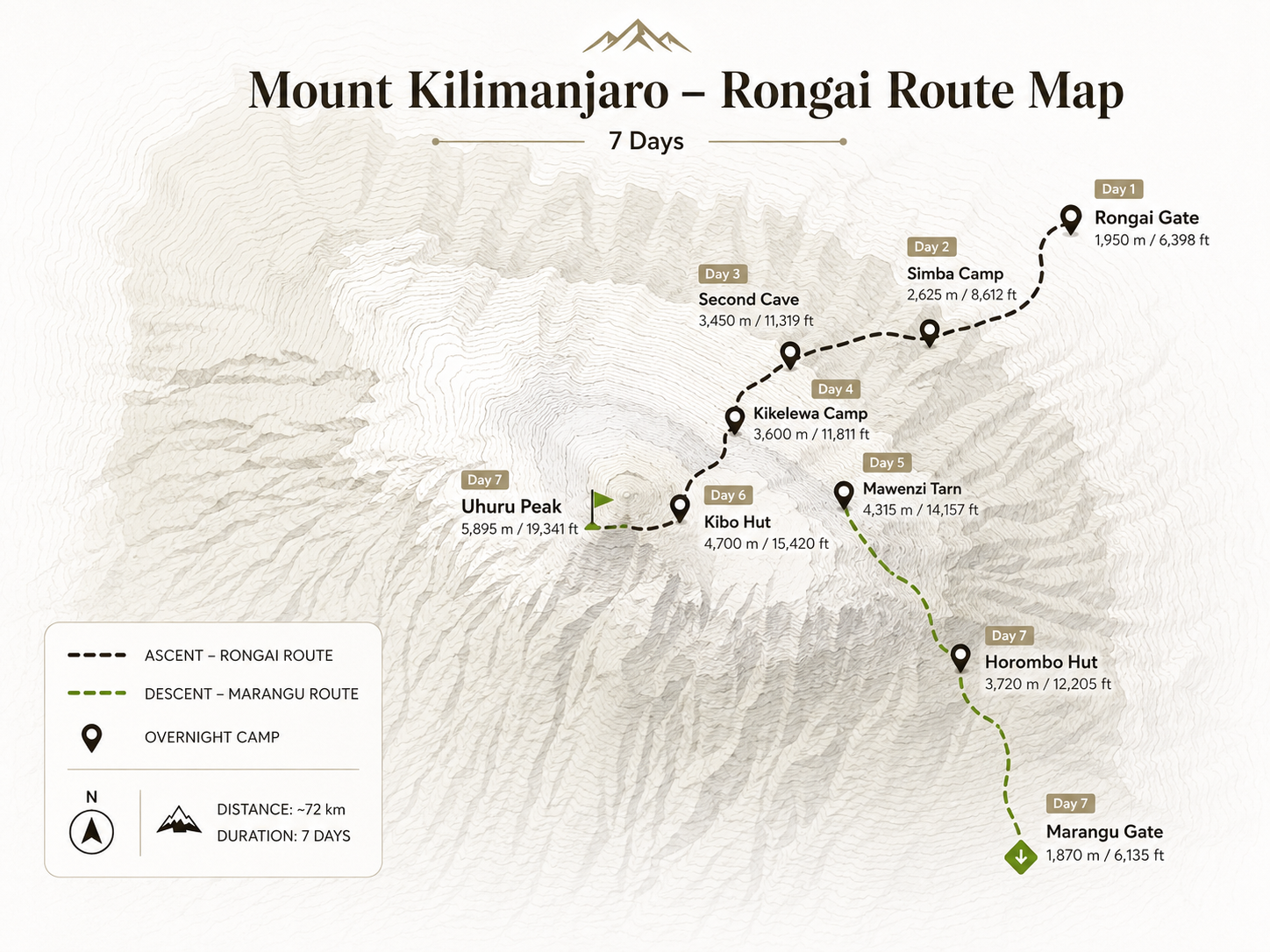
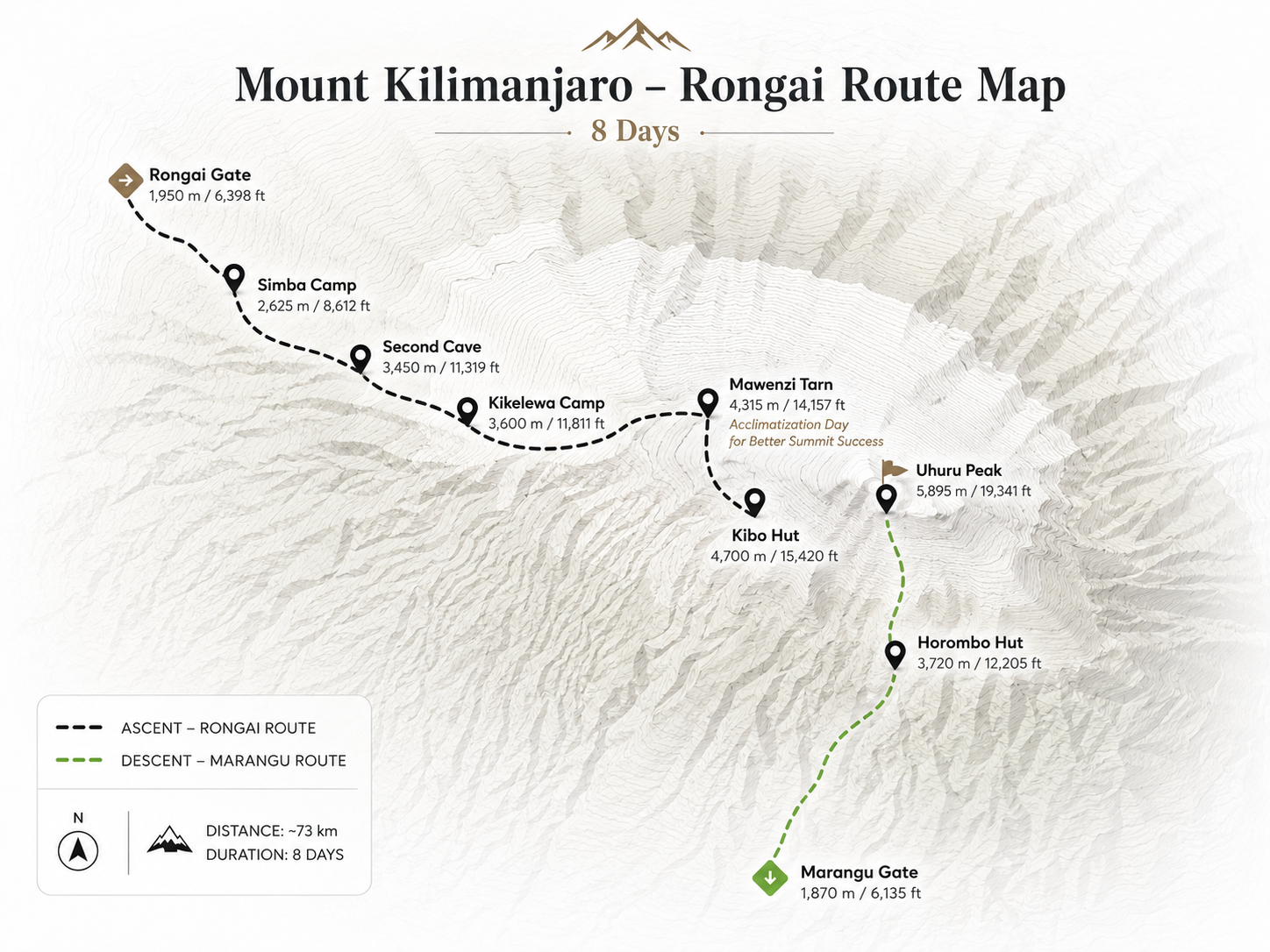
Visual Guide
Надморска височина Профил
Маршрута Програма
Your Rongai Route adventure begins with a 2.5-3 hour drive from Moshi, winding through rural farmlands and villages to the northern side of Kilimanjaro. You arrive at Rongai Gate (1,950m) near Nale Moru village. The only Kilimanjaro trailhead on the northern, Kenyan-border side of the mountain. Park registration is completed and your Haven Trails crew organizes equipment before the first steps are taken.
The trail begins gently through maize and potato fields, then enters pine plantation before transitioning into the montane rainforest. The path winds upward at a consistently gradual, manageable pace. This is the Rongai's signature character. Watch for the distinctive Black and White Colobus monkeys in the forest canopy. As the trees begin to thin, the views north toward Kenya open up dramatically. The vast Amboseli and Tsavo plains stretch out below and on a clear day, you may catch glimpses of elephant herds or giraffes on the plains far below. After 3-4 hours you reach Simba Camp (2,600m), your first night on the mountain, at the edge of the moorland zone.
Today is the longest walking day of the route and the first full immersion into Kilimanjaro's moorland zone. You leave the forest behind and enter a world of heather, giant lobelias and sweeping panoramic views. The path climbs steadily north-east and from the upper moorland you can feel the scale of the mountain for the first time. Kibo's dome is now clearly visible above you to the west and the Kenyan plains seem to drop away endlessly to the north.
You pass Second Cave (3,450m), a natural rock shelter used historically by herders, for a lunch break. From here the trail leaves the main track and follows a smaller, more intimate path toward the jagged silhouette of Mawenzi Peak. The landscape is remote and wild. This is the Rongai's great gift to its trekkers. You arrive at Kikelewa Caves Camp (3,600m) in the afternoon, having completed one of the most scenic moorland days of any Kilimanjaro route. The open views are stunning. Altitude is being felt now and your guides monitor everyone carefully.
Today's hike is shorter in distance but steeper than anything you've encountered so far. The trail climbs sharply up a grassy slope from Kikelewa Caves, exiting the heath zone and entering the high alpine desert zone. The vegetation becomes increasingly sparse. You are now clearly in the high-altitude world. The dramatic spires of Mawenzi Peak tower directly overhead, their jagged volcanic rock columns unlike anything else on the mountain. Mawenzi (5,149m) is Kilimanjaro's second highest peak and one of the most striking alpine formations in Africa.
You arrive at Mawenzi Tarn Hut (4,300m) in time for lunch. A beautiful camp nestled in the shadow of Mawenzi's magnificent spires, beside a high-altitude glacial tarn. The remainder of the afternoon is yours to rest, explore close by or photograph the dramatic surroundings. Your guides monitor altitude. Oxygen saturation checks are standard. On the 6-day route you push on to Kibo Hut tomorrow; on the 7-day route, this is your acclimatization base.
Today you cross the Saddle. One of Kilimanjaro's most surreal landscapes. The Saddle is the high barren plateau that stretches between the two peaks of Kibo and Mawenzi, sitting at around 4,300-4,500m. It is a vast, wind-scoured alpine desert of volcanic scree and dust with absolutely no vegetation. The landscape is otherworldly and deeply impressive. Like walking on the surface of the moon. Behind you, Mawenzi's jagged towers recede. Ahead, Kibo's smooth volcanic dome fills the entire sky.
The walk is long but the gradient is gentle. A steady, manageable traverse. You pass from the Rongai Route into the Marangu Route at Kibo Hut (4,700m). The point where both routes merge for the final push. The hut is a stone shelter building with basic facilities. You will share this space with Marangu Route trekkers tonight. Eat dinner early, pack your summit gear and rest as much as you can. The alarm is set for around 11:00pm or midnight. Summit night begins in just a few hours.
Околу полноќ, вашиот водич ве буди. Температурата надвор од Kibo Hut е близу до нулата или под неа, а темнината е целосна, освен расфрланите челни ламби што веќе се движат по падината над вас. Се облекувате внимателно. Секој слој се облекува по правилен редослед. Термоосновен слој, флис, изолирана јакна, долга перјана јакна, дебели ракавици, балаклава, очила. Ја ставате челната ламба и ги правите првите чекори нагоре во ноќта.
The Rongai summit route climbs the northeastern crater wall via switchbacks on the volcanic scree slope. The footing is loose and demanding. Every step a conscious effort at this altitude. Your guide sets a slow, rhythmic pace. "Pole pole." You breathe. You step. You count your breaths. The hours blur. At dawn, after 5-7 hours of climbing, you crest the crater rim at Gilman's Point (5,756m). And the sunrise blazing over Mawenzi Peak on the horizon stops your heart with its beauty. You are at the roof of the African continent's sky.
Then the final 45-minute walk along the crater rim. Past enormous glaciers glowing gold in the morning light. To Uhuru Peak (5,895m). Africa's highest point. The moment is overwhelming, exhausting, joyful and profoundly still. After photos and celebration, you descend. The Rongai route descends via the Marangu path. Steep and relentless on tired legs. You pass back through Kibo Hut for a brief rest, then continue all the way down to Horombo Hut (3,720m), arriving in late afternoon. You sleep deeply and gratefully.
Your final day on Kilimanjaro. Every muscle in your legs remembers yesterday's summit push but the warm air and descending altitude reinvigorate you step by step. From Horombo Hut (3,720m) you follow the Marangu route south through the moorland and back into the montane forest. You pass Mandara Hut along the way. A pleasant stopping point for final snacks and farewells with passing trekkers.
По 5–7 часа спуштање, пристигнувате до портата Марангу (1.830 м). Југоисточниот излез од планината. Вашите водичи и носачи се собираат на завршната прослава. Традиционални песни, танцување и искрени честитки. Го добивате вашиот официјален сертификат за искачување на Килиманџаро (златен за врвот Ухуру). Возењето назад до Моши е тивко, исполнето со размислување и длабоко задоволство. Се искачивте на највисоката планина во Африка. И тоа од страната што ја гледаат помалку од 10% од планинарите.
The same peaceful, scenic opening day as the 6-day option but knowing you have an extra day built into your schedule gives you a completely different psychological experience from the start. There's no urgency. Just presence. After the 2.5-3 hour drive from Moshi through rural northern Tanzania farmlands, you arrive at Rongai Gate (1,950m) near the Kenya border. Registration, gear check and introductions to your Haven Trails crew.
The trail climbs gently through maize fields, pine plantation and into the lush montane rainforest. Colobus monkeys appear in the canopy. The forest is cool and serene. As the trees thin toward the moorland zone, the Kenyan plains open up to the north in one of Kilimanjaro's most unexpected viewpoints. From up here, the plains of Amboseli and Tsavo National Parks seem to extend to the horizon and you may spot wildlife on the flats far below. Simba Camp (2,600m) greets you at the forest-moorland boundary after 3-4 comfortable hours. Dinner around the mess tent, early rest.
The day begins with a steady climb up into the moorland zone. Open, breezy and wide-sky beautiful. The character of the landscape changes completely from yesterday: heather shrubs give way to giant groundsels and lobelias; rocky ridges replace forest canopy. The trail continues northeast, with the Kenyan plains dropping away to the north and Kibo's dome becoming more clearly defined to the west.
Втората пештера (3.450 м) е местото за ручек. Природно засолниште во карпа со широки погледи. Оттука патеката го напушта главниот правец и продолжува по помирна и поинтимна траса кон Mawenzi. Попладне пристигнувате во кампот Kikelewa Caves (3.600 м), сместен покрај падината со широки погледи кон Kenya. Височината почнува да се чувствува. Дишењето забележливо се менува. Пијте доволно вода, вечерајте обилно и легнете рано. Утре ве очекува пократок, но пострмен ден.
Пократок ден со значително искачување. Од Кикелева, патеката стрмно се искачува по тревна падина во зоната на високопланинската пустина. Вегетацијата исчезнува. Воздухот забележливо се разредува со секој чекор нагоре. А потоа — Мавензи. Назабените вулкански кули на врвот Мавензи (5,149m) се издигнуваат директно над вас, а нивните стрмни карпести лица, обликувани со милиони години ерозија, создаваат речиси архитектонска композиција од врвови. Ова е едно од најдраматичните места за кампување на Килиманџаро.
Колибата Mawenzi Tarn (4.300 m) се наоѓа во природен сад под источното лице на Mawenzi, покрај мала глацијална канта што го рефлектира врвот над. Пристигнувате на време за ручек. Попладнето е твое. Одморете се во вашиот шатор, прошетајте кратки, фотографирајте ја околината. Вашите водичи вршат проверки на пулсна оксиметрија и ги следат симптомите на рани надморски височини. На 7-дневната рута, тука останувате две ноќи: вечерва за одмор и пристигнување и утре за активно аклиматизирање. Спијте добро. Утрешниот поход ја прави сета разлика.
This is the defining advantage of the 7-day route. And the reason summit success increases significantly. After breakfast, you head out with your guides on an acclimatization hike toward Mawenzi Ridge, climbing to around 4,600m before returning to camp. This "climb high, sleep low" cycle is one of the most powerful tools for high-altitude adaptation: your body produces more red blood cells in response to the higher altitude, then recovers at the lower sleeping altitude. Tomorrow's walk to Kibo Hut will feel significantly more manageable because of this day.
The ridge hike itself is extraordinary. You pick your way through the volcanic rock above the tarn, gaining altitude quickly, with ever-expanding views of Kibo's dome to the west and the Kenyan plains unfolding north. The wind picks up on the ridge. The air is thin but your body is strong. Return to Mawenzi Tarn Hut for a large lunch, afternoon rest and early dinner. This evening, pack your summit gear carefully. Tomorrow you cross the Saddle to Kibo Hut. The last camp before the top.
Today you cross the Saddle. Kilimanjaro's high, barren plateau between the two volcanic peaks of Kibo and Mawenzi. The Saddle is around 4,300-4,500m and utterly devoid of vegetation: a vast moonscape of grey volcanic scree stretching for kilometres between two giants. Mawenzi's jagged towers recede behind you as Kibo's enormous smooth dome draws you forward. The sky here is enormous. The silence is complete except for wind and footsteps.
The walk is long but the gradient is gentle, which is a welcome respite after the steeper days behind you. Your body. Well acclimatized from yesterday's ridge hike. Moves steadily through the thin air. You arrive at Kibo Hut (4,700m) in the early afternoon. The stone hut is shared with Marangu Route trekkers. Guides run final briefings: summit timing, pacing, emergency protocols, the exact path to Gilman's Point. Eat everything you can. Drink water until it's uncomfortable. Sleep as early as possible. The alarm comes around 11pm.
Алармот се огласува околу полноќ. Станувате од вреќата за спиење во студената, неподвижна темнина. Го облекувате секој слој. Термо-поткошула, флис, изолирана јакна, долга перјана јакна, дебели ракавици, подкапа. Ја вклучувате челната ламба. Последна голтка топол чај ако стомакот ви дозволува, а потоа излегувате. Ноќното небо над Kilimanjaro. На 4,700m, без никакво светлосно загадување. Една од најспектакуларните глетки на Земјата. Ѕвездите блескаат во милиони додека започнувате со бавно, рамномерно искачување.
Маршрутата за искачување Rongai се движи по североисточниот ѕид на кратерот, преку бескрајни цик-цак серпентини по вулкански сипар. Подлогата е напорна. Надморската височина е огромна. Вашиот водич го одредува темпото. Болно бавно, намерно така. „Pole pole.“ Здив по здив. Час по час. Редовно застанувате за кратки паузи и голтки вода. Потоа, по пет до седум часа искачување во темнината и студот, се искачувате на работ на кратерот кај Gilman's Point (5,756m), токму кога првите утрински зраци пламнуваат во портокалова и розова боја над силуетата на Mawenzi на источниот хоризонт. Изгрејсонцето на 5,756m е момент што трајно ги менува луѓето.
The final 45-minute walk along the crater rim to Uhuru Peak (5,895m) passes enormous glaciers glowing gold. You arrive at the summit sign. Africa's highest point. And everything you carried through the days and nights arrives with you. Then the long, leg-burning descent: down to Kibo for a rest, then on to Horombo Hut (3,720m). You arrive in late afternoon, exhausted and victorious. Sleep comes instantly.
Your final day. Well-rested from Horombo Hut after a full night's sleep at lower altitude, you begin the final descent through the moorland and back into the lush forest. The air grows richer and warmer with every downward step. You pass Mandara Hut on the way. A pleasant stop for tea and reflection. The forest closes in around you again: familiar, warm, alive with birdsong and the soft rustle of wind through the canopy.
По 5-7 часа се појавува Marangu Gate (1.830m). Патувањето е завршено. Вашите носачи и водичи се собираат за церемонијата: пеење, танцување, ракување во знак на заедничкиот триумф. Го добивате официјалниот сертификат за искачување на Kilimanjaro. Златен за оние што стоеле на Uhuru Peak. Емотивни збогувања. Возењето назад до Moshi е тивко и исполнето со размислување. Ја искачивте највисоката планина во Африка од нејзината најуникатна страна и видовте лице на Kilimanjaro со кое повеќето планинари никогаш не се среќаваат. Тоа засекогаш го носите со себе.
2026–2027 Цени
| Маршрута / Времетраење | 1 Лице | 2 лица | 3 лица | 4 лица | 5 лица | 6 лица |
|---|---|---|---|---|---|---|
| 6 дена | $ 2,271 | $ 1,877 | $ 1,739 | $ 1,670 | $ 1,676 | $ 1,628 |
| 7 дена | $ 2,533 | $ 2,117 | $ 1,965 | $ 1,891 | $ 1,899 | $ 1,849 |
The price is per person.
Ноќевање Запирања
| Камп / колиба | Надморска височина | Zone | Ноќ | Забелешки |
|---|---|---|---|---|
| Камп Simba (Прва пештера) | 2,600m | Раб на шума / планински пасишта | Ноќ 1 (двете) | Првата пештера во близина; отворени погледи на север над Кенија; Колобус мајмуни во областа |
| Пештери Кикелева (Трета пештера) | 3.600 m | Висорамнина | Ноќ 2 (двете опции) | По паузата за ручек кај Втората пештера; започнуваат погледите кон Мавензи; камп на отворен гребен |
| Колиба Мавензи Тарн | 4.300 м | Алпска пустина | Ноќ 3 (двете опции) · Ноќ 4 (7-дневна ) | Под шилците на Мавензи; глацијално езерце; најдраматичен камп; 7-дневна: 2 ноќевања со аклиматизациско искачување |
| Кибо колиба | 4.700 м | Арктичка зона / сипар | Ноќ 4 (6-дневно) · Ноќ 5 (7-дневно) | Камена колиба што се дели со други на маршрутата Marangu; базен камп за искачување; поаѓање на полноќ |
| Uhuru Peak | 5.895m | Врв / Арктик | N/A | Via Gilman's Point (5,756m); Rongai ascends northeastern crater wall |
| Колибата Horombo | 3.720 m | Висорамнина | Ноќ 5 (6-дневно) · Ноќ 6 (7-дневно) | Спуштање по патеката Marangu; заеднички колиби; последна ноќ на планината; заслужен одмор |
| Marangu Gate (излез) | 1.830 м | Шума | N/A | Ден 6 (6-дневна) / Ден 7 (7-дневна); сертификат за освоен врв; прослава со екипажот; враќање во Moshi |