Price per Person
1 Person$ 2,533
2 Persons$ 2,117
3 Persons$ 1,965
4 Persons$ 1,891
5 Persons$ 1,899
6 Persons$ 1,849
Our recommended Rongai itinerary. The only northern approach — with a full acclimatization day at Mawenzi Tarn, wildlife encounters, dramatic views and 85%+ summit success.
The 7-day Rongai Route is our recommended itinerary for this unique northern approach to Kilimanjaro. Beginning at Rongai Gate (1,950m) near the Kenya border, the route adds a crucial fourth day at Mawenzi Tarn Hut (4,300m) — a dedicated acclimatization day with an active hike toward Mawenzi Ridge (~4,600m) — before continuing to Kibo Hut, summit night and descent via the Marangu route.
This extra day makes a significant physiological difference. The "climb high, sleep low" acclimatization cycle at Mawenzi Tarn gives your body time to produce additional red blood cells and adapt to the altitude before the summit push. The result is a summit success rate of 85%+ compared to approximately 80% on the 6-day option. Most climbers on the 7-day route report feeling dramatically stronger and more comfortable on summit night.
Beyond the acclimatization advantage, the 7-day itinerary simply gives you more time to savour one of Kilimanjaro's most rewarding journeys. More time in the moorland. More time watching the Kenyan plains from northern camps. More time beneath the extraordinary spires of Mawenzi. It is the itinerary we recommend to virtually all of our clients — both first-time high-altitude trekkers and those returning to improve on a previous attempt.
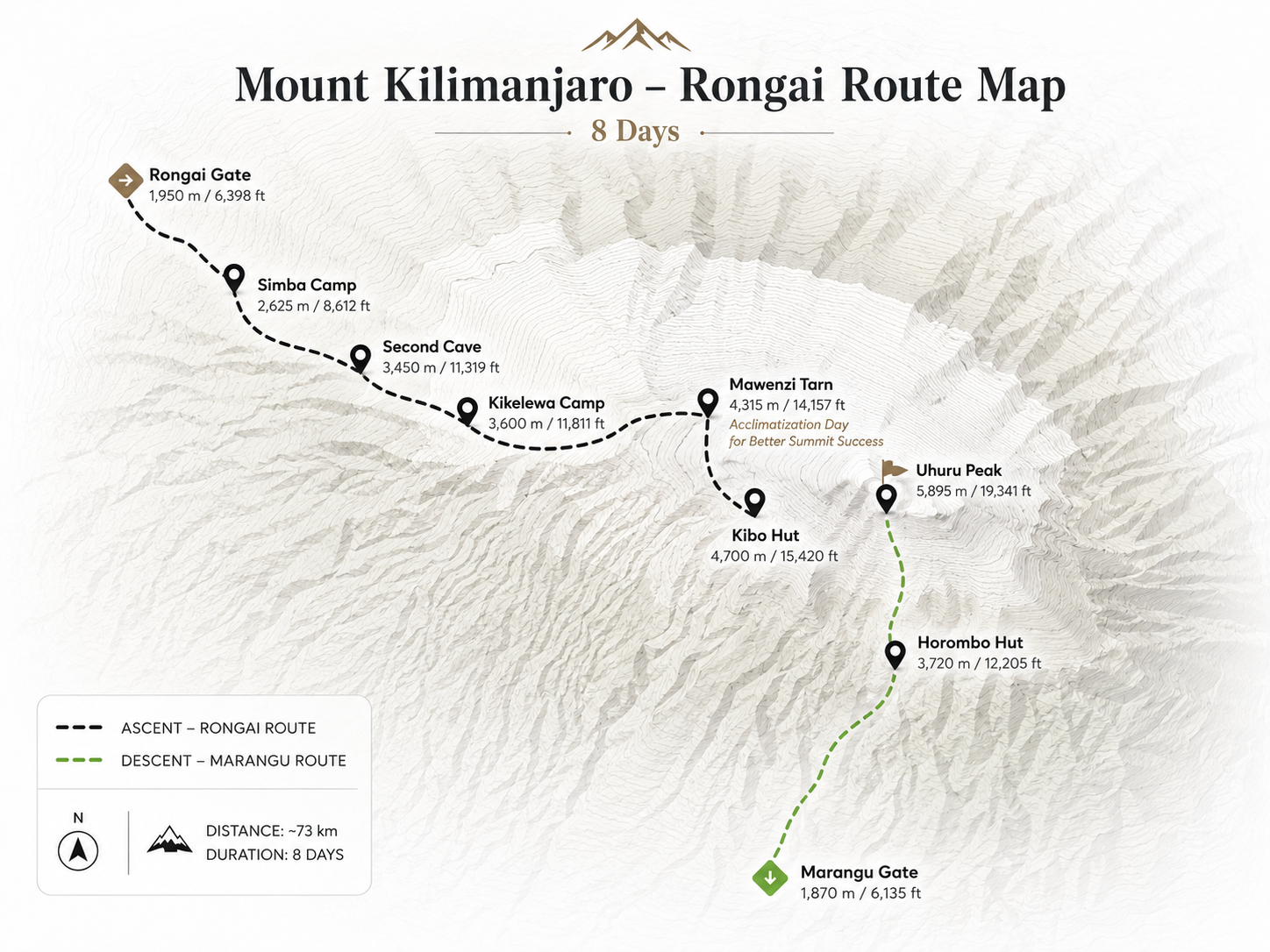
The same peaceful, scenic opening day as the 6-day option but knowing you have an extra day built into your schedule gives you a completely different psychological experience from the start. There's no urgency. Just presence. After the 2.5-3 hour drive from Moshi through rural northern Tanzania farmlands, you arrive at Rongai Gate (1,950m) near the Kenya border. Registration, gear check and introductions to your Haven Trails crew.
The trail climbs gently through maize fields, pine plantation and into the lush montane rainforest. Colobus monkeys appear in the canopy. The forest is cool and serene. As the trees thin toward the moorland zone, the Kenyan plains open up to the north in one of Kilimanjaro's most unexpected viewpoints. From up here, the plains of Amboseli and Tsavo National Parks seem to extend to the horizon and you may spot wildlife on the flats far below. Simba Camp (2,600m) greets you at the forest-moorland boundary after 3-4 comfortable hours. Dinner around the mess tent, early rest.
The day begins with a steady climb up into the moorland zone. Open, breezy and wide-sky beautiful. The character of the landscape changes completely from yesterday: heather shrubs give way to giant groundsels and lobelias; rocky ridges replace forest canopy. The trail continues northeast, with the Kenyan plains dropping away to the north and Kibo's dome becoming more clearly defined to the west.
Second Cave (3,450m) is your lunch stop. A natural rock shelter with expansive views. From here the trail leaves the main path and takes a quieter, more intimate line toward Mawenzi. By afternoon you arrive at Kikelewa Caves Camp (3,600m), tucked against the hillside with wide views toward Kenya. The altitude begins to make itself known. Breathing is noticeably different. Hydrate well, eat a full dinner and sleep early. Tomorrow is a shorter day but steeper.
A shorter day with a big altitude gain. From Kikelewa, the trail climbs sharply up a grassy slope into the high alpine desert zone. Vegetation disappears. The air grows noticeably thinner with each step upward. And then. Mawenzi. The jagged volcanic towers of Mawenzi Peak (5,149m) rise directly above you, their sheer rock faces sculpted by millions of years of erosion into an almost architectural arrangement of spires. It is one of the most dramatic camp settings anywhere on Kilimanjaro.
Mawenzi Tarn Hut (4,300m) sits in a natural bowl beneath Mawenzi's eastern face, beside a small glacial tarn that reflects the peak above. You arrive in time for lunch. The afternoon is yours. Rest in your tent, take short walks, photograph the surroundings. Your guides run pulse oximetry checks and monitor for early altitude symptoms. On the 7-day route, you stay here two nights: tonight to rest and arrive, and tomorrow to acclimatize actively. Sleep well. Tomorrow's hike makes all the difference.
This is the defining advantage of the 7-day route. And the reason summit success increases significantly. After breakfast, you head out with your guides on an acclimatization hike toward Mawenzi Ridge, climbing to around 4,600m before returning to camp. This "climb high, sleep low" cycle is one of the most powerful tools for high-altitude adaptation: your body produces more red blood cells in response to the higher altitude, then recovers at the lower sleeping altitude. Tomorrow's walk to Kibo Hut will feel significantly more manageable because of this day.
The ridge hike itself is extraordinary. You pick your way through the volcanic rock above the tarn, gaining altitude quickly, with ever-expanding views of Kibo's dome to the west and the Kenyan plains unfolding north. The wind picks up on the ridge. The air is thin but your body is strong. Return to Mawenzi Tarn Hut for a large lunch, afternoon rest and early dinner. This evening, pack your summit gear carefully. Tomorrow you cross the Saddle to Kibo Hut. The last camp before the top.
Today you cross the Saddle. Kilimanjaro's high, barren plateau between the two volcanic peaks of Kibo and Mawenzi. The Saddle is around 4,300-4,500m and utterly devoid of vegetation: a vast moonscape of grey volcanic scree stretching for kilometres between two giants. Mawenzi's jagged towers recede behind you as Kibo's enormous smooth dome draws you forward. The sky here is enormous. The silence is complete except for wind and footsteps.
The walk is long but the gradient is gentle, which is a welcome respite after the steeper days behind you. Your body — well acclimatized from yesterday's ridge hike — moves steadily through the thin air. You arrive at Kibo Hut (4,700m) in the early afternoon. The stone hut is shared with Marangu Route trekkers. Guides run final briefings: summit timing, pacing, emergency protocols, the exact path to Gilman's Point. Eat everything you can. Drink water until it's uncomfortable. Sleep as early as possible. The alarm comes around 11pm.
The alarm sounds at around midnight. You rise from your sleeping bag into cold, still darkness. Every layer goes on. Thermal base, fleece, insulated jacket, down parka, thick gloves, balaclava. Your headlamp goes on. A final drink of hot tea if your stomach allows it and then you step outside. The night sky above Kilimanjaro — at 4,700m with zero light pollution — is one of the most spectacular sights on Earth. Stars blaze in their millions as you begin the slow, steady ascent.
The Rongai summit route climbs the northeastern crater wall via endless zigzagging switchbacks on volcanic scree. The footing is demanding. The altitude is immense. Your guide sets the pace. Painfully slow, intentionally so. "Pole pole." Breath by breath. Hour by hour. You stop regularly for short breaks and sips of water. Then, after five to seven hours of climbing in the darkness and cold, you crest the crater rim at Gilman's Point (5,756m) just as the first light of dawn blazes orange and pink over Mawenzi's silhouette on the eastern horizon. The sunrise at 5,756m is a moment that changes people permanently.
The final 45-minute walk along the crater rim to Uhuru Peak (5,895m) passes enormous glaciers glowing gold. You arrive at the summit sign. Africa's highest point. And everything you carried through the days and nights arrives with you. Then the long, leg-burning descent: down to Kibo for a rest, then on to Horombo Hut (3,720m). You arrive in late afternoon, exhausted and victorious. Sleep comes instantly.
Your final day. Well-rested from Horombo Hut after a full night's sleep at lower altitude, you begin the final descent through the moorland and back into the lush forest. The air grows richer and warmer with every downward step. You pass Mandara Hut on the way. A pleasant stop for tea and reflection. The forest closes in around you again: familiar, warm, alive with birdsong and the soft rustle of wind through the canopy.
After 5-7 hours, Marangu Gate (1,830m) appears. The journey is complete. Your porters and guides gather for the ceremony: singing, dancing, the handshake of shared triumph. You receive your official Kilimanjaro Summit Certificate — gold for those who stood at Uhuru Peak. Emotional goodbyes. The drive back to Moshi is quiet and reflective. You have climbed Africa's highest mountain from its most unique side and seen a face of Kilimanjaro that most trekkers never encounter. You carry that with you forever.
Final selling price per person in USD.
| Camp / Hut | Altitude | Zone | Night | Notes |
|---|---|---|---|---|
| Simba Camp (First Cave) | 2,600m | Forest / Moorland edge | Night 1 | First Cave nearby; open views north over Kenya; colobus monkeys in area |
| Kikelewa Caves (Third Cave) | 3,600m | Moorland | Night 2 | After Second Cave lunch stop; Mawenzi views begin; open ridge camp |
| Mawenzi Tarn Hut | 4,300m | Alpine Desert | Night 3 & Night 4 | Beneath Mawenzi spires; glacial tarn; 2 nights — Day 4 acclimatization hike to ~4,600m |
| Kibo Hut | 4,700m | Arctic / Scree | Night 5 | Stone hut shared with Marangu route; summit base camp; midnight departure |
| Uhuru Peak | 5,895m | Summit / Arctic | N/A | Via Gilman's Point (5,756m); Rongai ascends northeastern crater wall |
| Horombo Hut | 3,720m | Moorland | Night 6 | Marangu route descent; shared huts; last night on mountain; well-earned rest |
| Marangu Gate (exit) | 1,830m | Forest | N/A | Day 7; summit certificate; crew celebration; return to Moshi |