Price per Person
1 Person$ 2,271
2 Persons$ 1,877
3 Persons$ 1,739
4 Persons$ 1,670
5 Persons$ 1,676
6 Persons$ 1,628
Mount Kilimanjaro's steepest, most direct southern ascent in 6 days. Near-total solitude, Barranco Wall scramble, Karanga acclimatization night and a midnight push to Africa's highest point.
The 6-day Umbwe Route is Kilimanjaro's most uncompromising standard itinerary. Combining the raw solitude and brutal steepness of the Umbwe's first two days with the critical acclimatization advantage of an overnight at Karanga Camp — the single step that separates it from the reckless 5-day option. This is a route for experienced, well-prepared trekkers who want the mountain to themselves on the lower slopes and are ready to work hard for every metre gained.
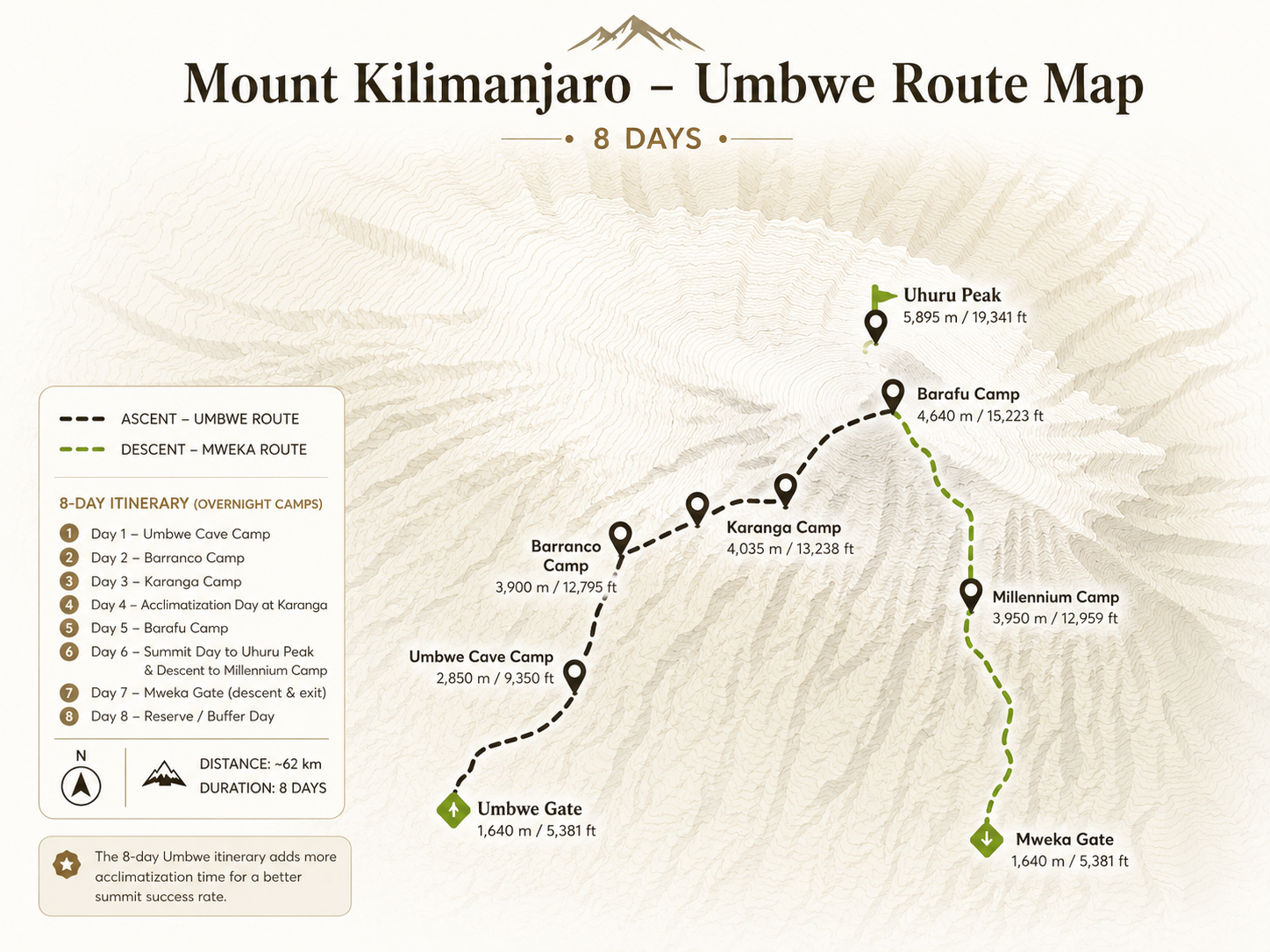
From Umbwe Gate (1,600m), the trail drives directly upward through dense rainforest along the narrow ridge between the Lonzo and Umbwe rivers. Gaining over 1,250 metres on Day 1 alone — the steepest opening day on any official Kilimanjaro route. Day 2 continues through the extraordinary Senecio Forest of giant groundsels to Barranco Camp (3,950m), where the route joins the Southern Circuit. Days 3 through 5 follow the iconic southern traverse: the Barranco Wall scramble, Karanga Valley beneath the glaciers, and the wind-blasted summit base at Barafu Camp (4,600m). Summit night departs at midnight. Descent is via the Mweka Route to Mweka Gate.
Summit success on the 6-day option runs at approximately 60-70% — significantly better than the 5-day's ~50%, thanks to the Karanga overnight which provides a meaningful acclimatization step. If you have strong high-altitude experience and excellent fitness, this is a worthy challenge. Haven Trails recommends the 7-day for first-time Kilimanjaro trekkers.
After registration formalities at Machame Gate and the short transfer to Umbwe Gate (1,600m), your Haven Trails crew is assembled and ready. The trailhead is quiet — almost no other trekkers. This is the Umbwe's defining first impression: solitude. The path enters the rainforest immediately and begins climbing without ceremony. Steeply, relentlessly, along the narrow ridge between the Lonzo and Umbwe rivers. The steepest opening day on any official Kilimanjaro route.
The rainforest is dense, cool and magnificent. Enormous ferns, moss-laden trees, ancient volcanic rock rising through thick undergrowth. The trail is well-defined but demands full attention and a steady, deliberate pace. Your guides set the rhythm: pole pole, always. After 5–7 hours of determined climbing, you reach Umbwe Cave Camp (2,850m) — a natural cave shelter and camp clearing near the forest-moorland transition. Your legs have earned the rest. Eat a full dinner, drink 3–4 litres of water and sleep as early as you can. You have gained 1,250 metres today. The mountain has announced itself.
The rainforest thins and gives way to something stranger and more spectacular: the Senecio Forest. Giant groundsels — prehistoric tree-plants found almost nowhere else on Earth — rise from the moorland in dense clusters, their enormous rosettes pointing skyward. The vegetation is otherworldly, unlike anything on Kilimanjaro's other routes at this stage of the trek. The path climbs steadily through heather and moorland before descending gently into Barranco Valley.
Barranco Camp (3,950m) appears dramatically, positioned beneath the sheer face of the Great Barranco Wall, with the Heim, Kersten and Decken Glaciers blazing white on the slopes above. This is where the Umbwe Route merges with the Southern Circuit and the Machame Route. The solitude of Days 1 and 2 gives way to a larger camp. Your guides run pulse oximetry checks and monitor everyone's acclimatization carefully. Tomorrow: the Barranco Wall. Eat well, hydrate aggressively, and rest early.
After an early breakfast, you face the Barranco Wall — arguably the single most iconic non-summit moment on all of Kilimanjaro. The Wall is a 257-metre volcanic cliff that looks, from below, like it should require ropes and harnesses. It does not. The route picks its way intelligently up solid volcanic rock, using good holds and natural ledges in a non-technical scramble requiring hands and feet. Your guides position themselves above to assist at key sections. The ascent takes 1–2 hours and every step delivers expanding views: the southern ice field above, the entire Barranco Valley below, and Tanzania's plains stretching to every horizon.
From the top of the Wall, the trail traverses east along the Southern Circuit, crossing the Karanga ravine and climbing beneath the spectacular icefalls of Kilimanjaro's southern glaciers. Heim, Kersten and Decken Glaciers glow white above you as you work across the rolling ridgeline. Karanga Camp (3,960m) sits in a beautiful sheltered valley with strong glacier views — one of the most dramatic camp positions on the route. This overnight is the 6-day option's key acclimatization advantage over the 5-day. Rest, eat and prepare mentally for the short push to Barafu tomorrow.
A shorter, purposeful day. The trail climbs from Karanga through the high alpine desert — sparse vegetation giving way to bare volcanic rock and scree, thin air, wide open sky. The junction with the Mweka descent trail is a significant waypoint: beyond here, the mountain only goes upward to the summit. Barafu Camp (4,600m) comes into view on its exposed, windswept ridge. You arrive in the early afternoon, maximizing rest time before the midnight alarm.
Barafu means "ice" in Swahili and the camp earns it. Wind can be ferocious. Temperatures plunge after dark. Your guides run thorough briefings: midnight departure, pacing strategy for the summit push, hydration and nutrition protocols, altitude distress signals and emergency procedures. Pack every layer in the correct order — thermal base at the bottom, summit shell at the top, gloves and balaclava accessible in one second in the dark. Eat everything on your plate. Set your alarm. The roof of Africa is approximately nine hours away.
Midnight. The alarm pierces the frozen silence of Barafu. You rise from your sleeping bag into cold, still darkness and dress methodically in every available layer. Your headlamp finds the first of thousands of steps upward. The scree slope stretches above you into blackness. Above — invisible in the darkness — Uhuru Peak waits at 5,895m. Your guide is steady, patient and completely focused on you. "Pole pole." One step. One breath. Hour after hour.
The ascent climbs the southern scree slopes via relentless switchbacks. The Umbwe Route summits via Stella Point (5,756m) on the crater's southern rim — a slightly different approach from the eastern routes. After 5–7 hours of darkness and determination, you crest the crater rim at Stella Point just as the sun rises over Mawenzi Peak and Tanzania's plains far below in a blaze of impossible colour. Then the final 30-minute walk along the crater rim — past the towering remains of Kilimanjaro's ancient glaciers — to Uhuru Peak (5,895m). Africa's highest point. The sign. The photograph. The tears. The silence. This moment is yours forever.
The descent via Mweka is long but your legs carry you on adrenaline and pride. Brief stop at Barafu for lunch, then continue down through the alpine desert as the forest returns and the air grows thick and warm. Mweka Camp (3,100m) arrives in late afternoon. Sleep comes before your head touches the pillow.
Your final morning on Kilimanjaro. Every muscle protests but every breath is richer at lower altitude and every step is downward, toward warm air and level ground. The descent from Mweka Camp (3,100m) through the upper forest zone is steep and sometimes slippery but the rich oxygen, warmth and birdsong of the forest zone are restorative after five nights above 2,850m. Birds call in the canopy. The temperature climbs. The forest closes in around you, green and alive.
After 3–5 hours, Mweka Gate (1,640m) appears. Your guides and porters gather for the celebration — traditional Kilimanjaro songs, dancing, proud handshakes and laughter. Your official Kilimanjaro Summit Certificate (gold for Uhuru Peak) is placed in your hands. The drive back to Moshi carries the quiet, deep satisfaction of someone who has done something genuinely hard. You chose the Umbwe Route — Kilimanjaro's hardest trail. You summited Africa. The mountain is unchanged, immense and indifferent. But you are not. You are changed forever.
Final selling price per person in USD.
| Night | Camp | Altitude | Zone | Notes |
|---|---|---|---|---|
| Night 1 | Umbwe Cave Camp (Cave Bivouac) | 2,850m | Rainforest / Moorland edge | Natural cave shelter; narrow ridge between Lonzo & Umbwe rivers; steepest Day 1 on Kilimanjaro |
| Night 2 | Barranco Camp | 3,950m | Moorland / Alpine | Umbwe route joins Southern Circuit here; beneath Great Barranco Wall; southern glaciers view; pulse oximetry checks |
| Night 3 | Karanga Camp | 3,960m | Alpine | After Barranco Wall scramble; beneath Heim, Kersten & Decken Glaciers; critical acclimatization night — not skipped on 6-day |
| Night 4 | Barafu Camp | 4,600m | Arctic Alpine Desert | Summit base camp; most exposed camp on Kilimanjaro; midnight departure; thorough summit briefing this evening |
| — | Uhuru Peak | 5,895m | Summit / Arctic | Via Stella Point (5,756m) on southern crater rim; midnight–dawn ascent; summit of Africa |
| Night 5 | Mweka Camp | 3,100m | Upper Forest | Post-summit descent camp; forest returns; last night on mountain; short descent to gate tomorrow |
| Day 6 Exit | Mweka Gate | 1,640m | Forest | Summit certificate awarded; crew celebration; return transfer to Moshi hotel |
| Group Size | Price Per Person | Notes |
|---|---|---|
| 1 Person (Solo) | $2,350 | Private group, dedicated crew |
| 2 People | $2,050 | Per person · private departure |
| 3–4 People | $1,950 | Per person · private group |
| 5–8 People | $1,850 | Per person · best value |
| 9+ People | Contact Us | WhatsApp for group rate |
Our team at Haven Trails Adventures will reach out within 24 hours to confirm your expedition and share your personalised itinerary.