Umbwe Route
Kilimanjaro's steepest, most direct and least crowded trail. A raw, uncompromising southern ascent for experienced trekkers who want the mountain to themselves.
The Direct Southern Challenge
The Umbwe Route is Kilimanjaro's most uncompromising trail. The shortest, steepest and most direct path to the summit. Starting at Umbwe Gate (1,600m) on the southern face, the route drives straight up through dense rainforest along a narrow ridge between the Lonzo and Umbwe rivers. The average gradient on Days 1 and 2 exceeds 21%. Steeper than any comparable section of any other official route. You are ascending fast, there are almost no other trekkers in sight and the mountain demands everything you have.
At Barranco Camp (3,950m) on Day 2, the route joins the Southern Circuit and merges with the Machame Route. From here the trail gains the dramatic variety that characterises Kilimanjaro's southern face: the Barranco Wall scramble, the Karanga Valley traverse beneath the southern glaciers and finally Barafu Camp (4,600m). The high alpine desert base camp where every route converges for the midnight summit push. The descent follows the Mweka route south, exiting at Mweka Gate.
The Umbwe's low success rates are a direct consequence of its compressed timeline. The body simply does not have enough days to acclimatize when the altitude gain is this fast. The 7-day option. Which adds a full acclimatization day at Barranco with a high-altitude hike toward Arrow Glacier. Is the only version we recommend to climbers who have not repeatedly trekked at extreme altitude. Even so, this is a route for experienced trekkers only. The reward for those who are ready: absolute solitude on the first two days, a wild and raw mountain experience and the satisfaction of Kilimanjaro's hardest approach.
Is the Umbwe Route Right for You?
- Most solitary experience almost no other trekkers on Days 1-2
- Shortest distance efficient use of time for experienced climbers
- Raw, wild mountain character. Steep ridge, dense forest, pure challenge
- Southern glaciers views. Approach beneath Heim, Kersten & Decken Glaciers
- Iconic Barranco Wall scramble included in Southern Circuit traverse
- Bragging rights Kilimanjaro's hardest route, fewest trekkers
- Lowest summit success rates especially on 5 and 6-day options
- No "climb high, sleep low" in first 2 days. Poor acclimatization profile
- Extremely steep Days 1-2 slippery when wet, physically brutal
- Not suitable for beginners or moderate hikers under any circumstances
- Rainy season especially hazardous trail becomes dangerously slick
Umbwe Route on the Map
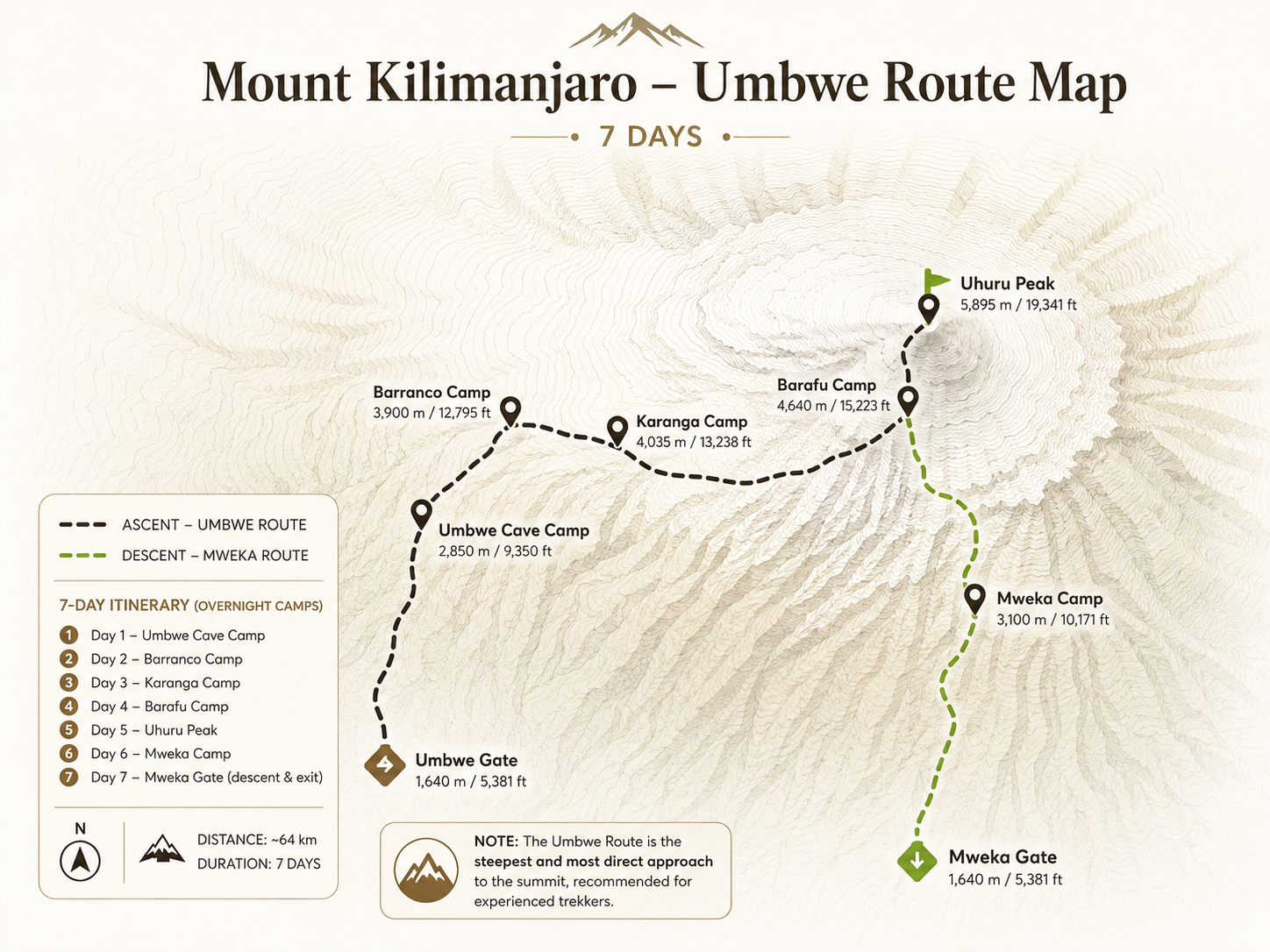
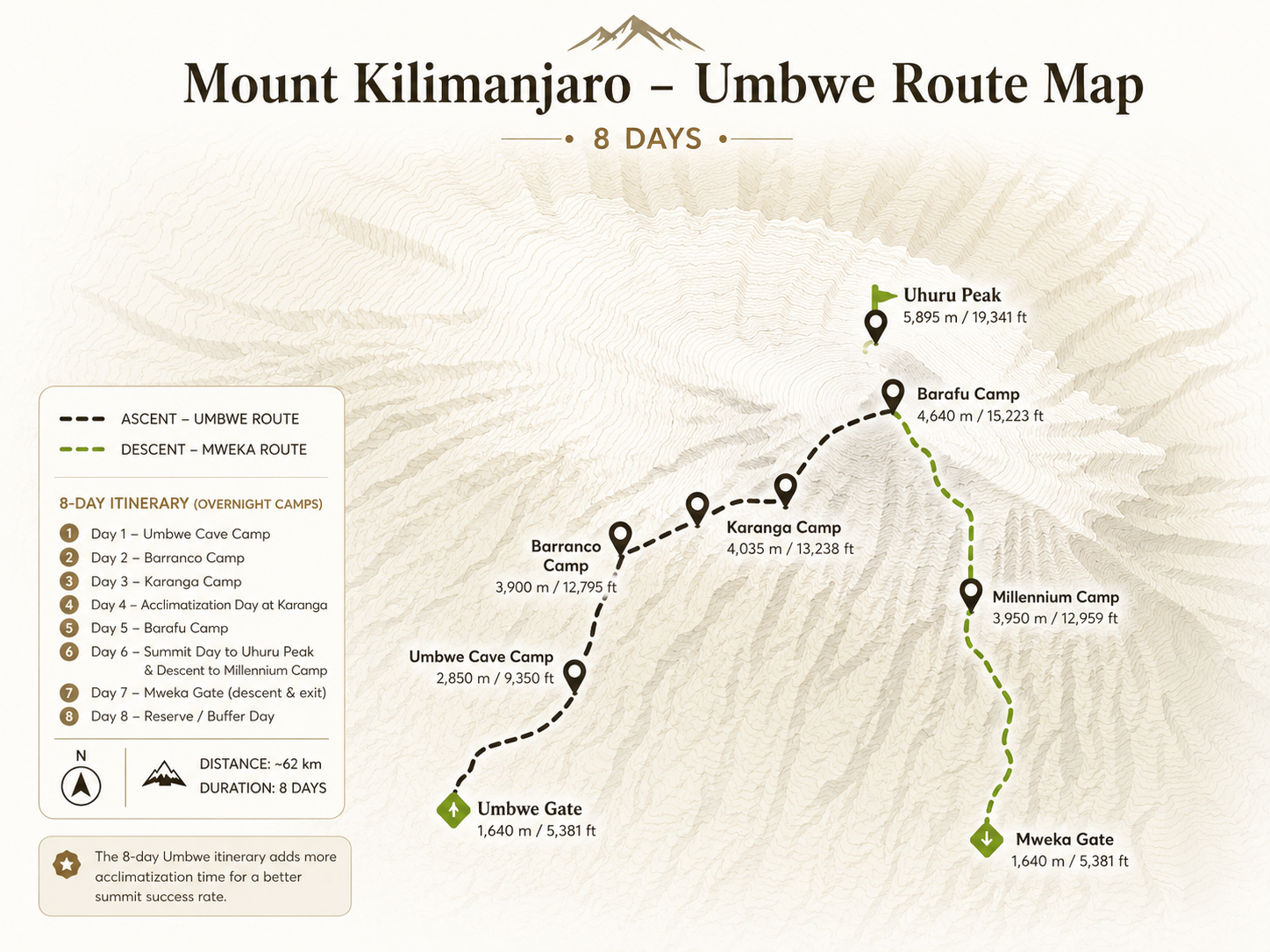
Visual Guide
Elevation Profile
Route Itinerary
After the drive from Moshi and registration formalities at Machame Gate, you transfer to Umbwe Gate (1,600m) at the base of the southern face. A quiet, unassuming trailhead with almost no other trekkers present. This is the Umbwe's defining character from step one: solitude. The trail enters the rainforest immediately and wastes no time on gradual approaches. It drives straight upward on a steep, narrow ridge between the Lonzo and Umbwe rivers, gaining altitude relentlessly.
The forest is dense and beautiful. Giant ferns, towering trees, mosses hanging thick from every branch. The trail is ancient-feeling and intimate, completely unlike the wider, busier paths of Machame or Lemosho. The steepness demands full attention and a consistent pace. After 5-7 hours of determined climbing, you reach Umbwe Cave Camp (2,850m). A natural cave shelter and camp site in a small clearing near the top of the forest zone. The altitude and exertion are already making themselves felt. Eat fully, drink plenty of water and rest as much as you can. Tomorrow is even more demanding.
Today the rainforest gives way to something stranger and more spectacular: the Senecio Forest. Here, giant groundsels (senecios). Prehistoric-looking tree plants unique to East African mountains. Rise from the moorland like ancient sentinels, their enormous rosettes pointing skyward. The vegetation is otherworldly, unlike anything on other Kilimanjaro routes at this stage. The path climbs steadily through the heather and moorland zone before descending slightly into Barranco Valley.
You arrive at Barranco Camp (3,950m). Dramatically positioned beneath the sheer face of the Great Barranco Wall, with the Heim, Kersten and Decken Glaciers visible on the slopes above. This is where the Umbwe route joins the Southern Circuit and the Machame Route. The Western Breach. Kilimanjaro's most direct but most hazardous summit line. Towers to your left. You will summit from Barafu via Stella Point instead. On the 5-day option, you push to Barafu tomorrow without stopping at Karanga. Prepare your body. Eat well, hydrate aggressively and respect the altitude.
This is the most physically demanding day of the 5-day route. You begin with the Barranco Wall. A 257-metre non-technical scramble up the face of the volcanic cliff that forms the southern wall of Barranco Valley. Despite its fearsome appearance, the Wall uses good hand and foot holds on solid rock and your guides position themselves above to assist. The ascent takes 1-2 hours and rewards you with extraordinary views from the top. On 5-day, there is no stopping at Karanga.
After the Wall, the trail traverses south and east along a rolling ridge line above the Karanga Valley. Crossing several steep ravines and ridges beneath the vast southern glaciers. The Karanga valley junction appears but you push through without camping. The trail climbs steadily through the high alpine desert to Barafu Camp (4,600m), arriving in the early afternoon. Barafu is harsh, wind-exposed and cold. The altitude now demands everything. Headaches are common. Eat, hydrate relentlessly and sleep as early as possible. The midnight alarm comes in just hours.
Midnight. Your guides wake you into absolute cold and darkness. You dress in every layer available. Thermal, fleece, insulated jacket, down parka, balaclava, thick gloves. And step out into the night. Above you, Kilimanjaro's summit rises invisible in the darkness, cold and vast. Your headlamp's beam shows only the scree slope ahead, one step at a time.
The ascent climbs the southern crater wall via endless switchbacks. The Umbwe Route summits via Stella Point (5,756m) on the crater rim. Slightly different from routes that approach Gilman's Point from the east. The scree is demanding and the altitude is extreme. Pole pole. Hour after hour. Then. At dawn, after 5-7 hours. You crest the crater rim at Stella Point just as the sun rises in a blaze of gold and crimson over the African horizon. The final 30-minute walk along the crater rim to Uhuru Peak (5,895m) is emotional, exhausted and unforgettable. Africa's highest point. You've earned it.
The descent via Mweka is long and relentless on depleted legs. Brief stop at Barafu for lunch, then continue down to Mweka Camp (3,100m). The forest returns. The air grows rich. You arrive shattered, victorious, and changed.
Your final day. Every muscle protests but every breath is richer, every step closer to warm air and level ground. The descent from Mweka Camp (3,100m) through the upper forest zone is steep and sometimes muddy but gloriously alive. Birds, warmth and the smell of damp earth replacing yesterday's volcanic cold. After 3-5 hours you arrive at Mweka Gate (1,640m).
Your guides and porters gather for the traditional celebration. Songs, handshakes, laughter. Your official Kilimanjaro Summit Certificate is presented. The drive back to Moshi carries you off the mountain and into the ordinary world, which will never feel quite the same again. You climbed Kilimanjaro's hardest route, in the shortest time. That is something very few people on Earth can say.
After registration at Machame Gate and the transfer to Umbwe Gate (1,600m), your Haven Trails crew is ready and waiting. There are almost no other trekkers here. This is the Umbwe Route's defining first impression. The path enters the rainforest immediately and begins climbing steeply along the narrow ridge between the Lonzo and Umbwe rivers. The trail is well-defined but unrelenting. The steepest opening day on any official Kilimanjaro route.
The forest is dense, cool and magnificent. Enormous ferns, moss-covered trees, ancient volcanic rock rising through the undergrowth. You gain over 1,250 metres in a single day. By the time you arrive at Umbwe Cave Camp (2,850m). A natural cave shelter in a small clearing near the forest-moorland transition. Your legs know exactly what they've carried you through. Eat a full dinner, drink 3-4 litres of water and sleep early. The mountain has announced itself clearly.
The rainforest thins and gives way to the Senecio Forest. One of Kilimanjaro's most extraordinary ecological transitions. Giant groundsels rise from the moorland in prehistoric clusters, their massive rosettes and thick trunks creating an alien landscape found almost nowhere else on Earth. The path continues upward through heather and moorland before the trail begins to flatten and descend gently toward Barranco Valley.
Barranco Camp (3,950m) appears dramatically. Perched beneath the sheer face of the Great Barranco Wall, with the southern glaciers of Kilimanjaro blazing white above. This is where the Umbwe route merges with the Machame Route and the Southern Circuit. The solitude of the first two days is replaced by the energy of a larger camp, with trekkers from different routes converging here. The altitude is significant. Your guides run pulse oximetry checks and monitor everyone carefully. Early to bed.
After an early breakfast, you face the Barranco Wall. Arguably the single most iconic moment on Kilimanjaro's southern face. The Wall is a 257-metre volcanic cliff that looks, from below, like it should require ropes and harnesses. It does not. The route follows natural volcanic rock holds. Hands and feet working together in a non-technical scramble that all fitness levels can complete with proper guidance. Your guides position themselves above to assist at exposed sections. The ascent takes 1-2 hours and is genuinely exciting.
From the top of the Barranco Wall, the views are extraordinary. The entire southern face of Kilimanjaro stretches above you, glaciers hanging from the volcanic cap, the plains of Tanzania dropping away thousands of metres below. The trail then traverses east across a series of ridges and valleys, crossing the Karanga stream and climbing steeply one final time to Karanga Camp (3,960m). This camp sits beneath the icefalls of Kilimanjaro's famous southern glaciers. Heim, Kersten and Decken. A dramatic and beautiful setting. Rest, eat and prepare mentally for the push to Barafu tomorrow.
A shorter, important day. The trail climbs from Karanga through the high alpine desert. Sparse vegetation giving way to bare volcanic rock and scree. The route connects with the Mweka descent trail junction before continuing upward to Barafu Camp (4,600m). You arrive in the early afternoon, which gives the maximum possible time for rest before the midnight summit push.
Barafu is harsh and exposed. The name means "ice" in Swahili and the camp earns it. The wind can be ferocious. Temperatures drop sharply after dark. Your guides brief you thoroughly on the summit route: the midnight start, pacing strategy, the switchback ascent to Stella Point, emergency protocols. Eat as much as your altitude-suppressed appetite allows. Pack your summit gear in a specific order so every layer is accessible quickly in the cold dark. Set your alarm. Tomorrow night, you reach the roof of Africa.
Midnight. The alarm pierces the frozen silence of Barafu. You rise from your sleeping bag into cold, still darkness and dress methodically in every available layer. Your headlamp illuminates the scree slope above as you take your first steps into the summit night. Above. Invisible in the darkness. Uhuru Peak waits at 5,895m. It has waited for millions of years. It can wait a few more hours.
The ascent climbs the southern scree slopes via relentless switchbacks. "Pole pole." Step by step. Breath by deliberate breath. The cold is extraordinary. Your guide maintains a slow, rhythmic pace. Any faster and altitude wins. After 5-7 hours of darkness and effort, you crest the crater rim at Stella Point (5,756m). The sunrise erupts over the horizon in colours that have no name. Then the 30-minute walk along the crater rim past towering glaciers to Uhuru Peak (5,895m). Africa's highest point. The sign. The tears. The summit hug. The silence. This moment is yours forever.
The descent via Mweka is long but your legs carry you down on adrenaline and pride. Barafu for lunch, then Mweka Camp (3,100m) by late afternoon. Sleep arrives before your head touches the pillow.
Your final morning on Kilimanjaro. Sore legs, a full heart, and a certificate waiting. The descent from Mweka Camp (3,100m) through the upper forest zone is steep and sometimes slippery but every step is downward, and the rich air at lower altitude feels extraordinary after days above 4,000m. Birds sing in the canopy. The temperature climbs. The forest closes in around you.
After 3-5 hours, Mweka Gate (1,640m) appears. Your guides and porters gather for the celebration. Traditional Kilimanjaro songs, dancing, proud handshakes. Your official Summit Certificate is presented. Gold for those who reached Uhuru Peak. The drive back to Moshi is quiet and warm. You have climbed Kilimanjaro's steepest route. The mountain gave everything and so did you.
Registration at Machame Gate, then a transfer to Umbwe Gate (1,600m). Almost no other trekkers. The Umbwe Route's signature. The trail enters the rainforest immediately, climbing steeply along the ridge between the Lonzo and Umbwe rivers. Dense, beautiful and unrelenting. Over 1,250 metres gained today. After 5-7 hours, Umbwe Cave Camp (2,850m). A natural cave shelter and clearing near the forest-moorland edge. Eat fully, hydrate aggressively and sleep early.
The forest transitions into the extraordinary Senecio Forest. Giant groundsels rising prehistoric and otherworldly from the moorland. The trail climbs steadily before descending into Barranco Valley. At Barranco Camp (3,950m), dramatically positioned beneath the Great Barranco Wall and the southern glaciers, the Umbwe route joins the Southern Circuit and the Machame Route. The solitude of the first two days gives way to a larger communal camp. Your guides monitor altitude carefully. Pulse oximetry checks for everyone. Early dinner, early rest. On the 7-day option, tomorrow you do not move camp. You acclimatize here. This is the key advantage.
This is the defining advantage of the 7-day Umbwe Route. The day that separates a reasonable summit attempt from a desperate one. You do not move camp today. Instead, after breakfast, your guide leads you up the Western Breach approach trail toward Arrow Glacier, climbing to approximately 4,800m before returning to Barranco. This "climb high, sleep low" cycle is altitude physiology at its most powerful: your body rapidly produces additional red blood cells in response to the high altitude exposure, then recovers at the lower sleeping elevation. The result is a body significantly better prepared for summit night.
The hike itself is spectacular. You gain the upper slopes of the Western Breach route, surrounded by increasingly dramatic glacier formations, with extraordinary views of the southern ice field and the vast Tanzanian plains far below. Return to Barranco Camp for a large lunch, afternoon rest, and early dinner. Pack your summit gear tonight. Tomorrow the Barranco Wall awaits, followed by Karanga and then Barafu. You are now better acclimatized than any trekker on the 5 or 6-day option.
Well-rested and well-acclimatized from yesterday's rest and hike, you begin the day with Kilimanjaro's most iconic non-summit moment: the Barranco Wall. The 257-metre volcanic cliff looks near-vertical from below. But the route picks its way intelligently up solid volcanic rock, using good holds and natural ledges in a non-technical scramble requiring hands and feet. Your guides assist at key points. It takes 1-2 hours and delivers extraordinary views from the top: the southern ice field above, the entire Barranco Valley below and Tanzania's plains stretching to every horizon.
From the top of the Wall, the trail traverses east along the Southern Circuit. Crossing the Karanga ravine and climbing beneath the spectacular icefalls of Kilimanjaro's southern glaciers. The Heim, Kersten and Decken Glaciers glow white above you. Karanga Camp (3,960m) is a beautiful, intimate camp in a valley with strong glacier views. Tomorrow is a short push to Barafu. Tonight, sleep comes easily. You have earned it and you are ready.
A short, focused day. The trail climbs from Karanga through the high alpine desert. Bare volcanic rock and scree, thin air, wide open sky. The Mweka descent trail junction marks an important waypoint: beyond here, everything is upward to the summit. Barafu Camp (4,600m) comes into view on a windswept ridge. Stark, cold and purposeful. This is where all routes converge for the final push. You arrive early afternoon, giving maximum rest time.
Your guides run comprehensive briefings: midnight departure time, precise pacing, hydration and nutrition strategy during the summit push, signals for altitude distress and emergency procedures. Pack every layer in the correct order. Thermal base at the bottom, summit shell at the top, gloves and balaclava accessible in one second in the dark. Eat everything on your plate. Set two alarms. The roof of Africa is approximately nine hours away.
Midnight. The alarm. The cold. The darkness. You dress methodically and step outside into a night sky blazing with stars. Your headlamp finds the first of ten thousand steps upward. The scree slope stretches above you into blackness. "Pole pole." Your guide is steady, patient, and completely focused on you. One step. One breath. Hour after hour.
Five to seven hours of darkness and determination bring you to Stella Point (5,756m) at the crater rim, just as the sun rises over Mawenzi Peak and the African plains far below in a dawn of impossible colour. The final 30 minutes along the crater rim. Past the towering remains of Kilimanjaro's ancient glaciers. Leads to Uhuru Peak (5,895m). Africa's highest point. The sign, the tears, the photograph, the silence. It is everything you imagined and more.
The descent via Mweka is long and relentless. Down through Barafu for lunch, down through the alpine desert, down until the forest returns and the air grows thick and warm. Mweka Camp (3,100m) arrives in late afternoon. You sleep before dark.
Your final morning. The body aches, the heart is full. The descent from Mweka Camp (3,100m) through the upper forest is steep and occasionally muddy but the rich air, warmth and birdsong of the forest zone are restorative after days in the high alpine cold. After 3-5 hours, Mweka Gate (1,640m). The ceremony: your guides and porters sing, dance and celebrate. Your official Kilimanjaro Summit Certificate. Gold for Uhuru. Is placed in your hands.
The drive back to Moshi carries the quiet satisfaction of someone who has done something genuinely hard. You chose the Umbwe Route, the hardest path. You chose the 7-day option, the wise path. And you reached the roof of Africa. The mountain is still there. Unchanged, immense, indifferent. But you are not. You are changed forever.
Overnight Stops
| Camp | Altitude | Zone | Night | Notes |
|---|---|---|---|---|
| Umbwe Cave Camp (Cave Bivouac) | 2,850m | Rainforest / Moorland edge | Night 1 (all options) | Natural cave shelter; ridge between Lonzo & Umbwe rivers; steepest approach day on Kilimanjaro |
| Barranco Camp | 3,950m | Moorland / Alpine | Night 2 (all) · Night 3 (7-day ) | Joins Southern Circuit & Machame route; under Barranco Wall; southern glaciers view; 7-day: 2 nights with Arrow Glacier acclimatization hike |
| Karanga Camp | 3,960m | Alpine Desert | Night 3 (6-day) · Night 4 (7-day) · Skipped on 5-day | After Barranco Wall scramble; beneath S. glaciers; key acclimatization night missing on 5-day |
| Barafu Camp | 4,600m | Arctic / Alpine Desert | Night 4 (5&6-day) · Night 5 (7-day) | Summit base camp; most exposed camp on Kilimanjaro; all routes converge here; midnight departure |
| Uhuru Peak | 5,895m | Summit / Arctic | N/A | Via Stella Point (5,756m); Umbwe ascends southern scree wall; summit of Africa |
| Mweka Camp | 3,100m | Upper Forest | Night 5 (5-day) · Night 5 (6-day) · Night 6 (7-day) | Post-summit descent camp; forest returns; last night on mountain; descent via Mweka route |
| Mweka Gate (exit) | 1,640m | Forest | N/A | Day 5/6/7 depending on option; summit certificate; crew celebration; return transfer to Moshi |