5 Days Umbwe Route
Kilimanjaro's steepest, most direct ascent compressed into 5 days. The fastest official route to the summit, for expert trekkers only with prior high-altitude summit history.
5 Days Up Kilimanjaro's Hardest Route
The 5-day Umbwe Route is Kilimanjaro's most uncompromising itinerary. Starting at Umbwe Gate (1,600m), the trail drives straight up through dense rainforest along a narrow ridge between the Lonzo and Umbwe rivers. The average gradient on Days 1 and 2 exceeds 21%. Steeper than any comparable section of any other official route. At Barranco Camp (3,950m) on Day 2, the route joins the Southern Circuit and Machame Route.
On the 5-day option, Day 3 is the defining challenge: after the Barranco Wall scramble, there is no overnight stop at Karanga. You push directly from Barranco to Barafu (4,600m), skipping the critical Karanga acclimatization night entirely and nearly doubling the altitude gain in a single stage. This compressed timeline gives your body the least possible time to acclimatize of any standard Kilimanjaro itinerary. Summit night follows the next midnight from Barafu, and descent is via the Mweka route.
The 5-day option is reserved for trekkers who have repeatedly summited peaks above 5,000m and have documented excellent acclimatization response. It rewards those who qualify with complete solitude on Days 1 and 2, wild mountain character, and the satisfaction of Kilimanjaro's fastest and hardest ascent.
Umbwe Route Duration Options
5-Day Umbwe Route on the Map
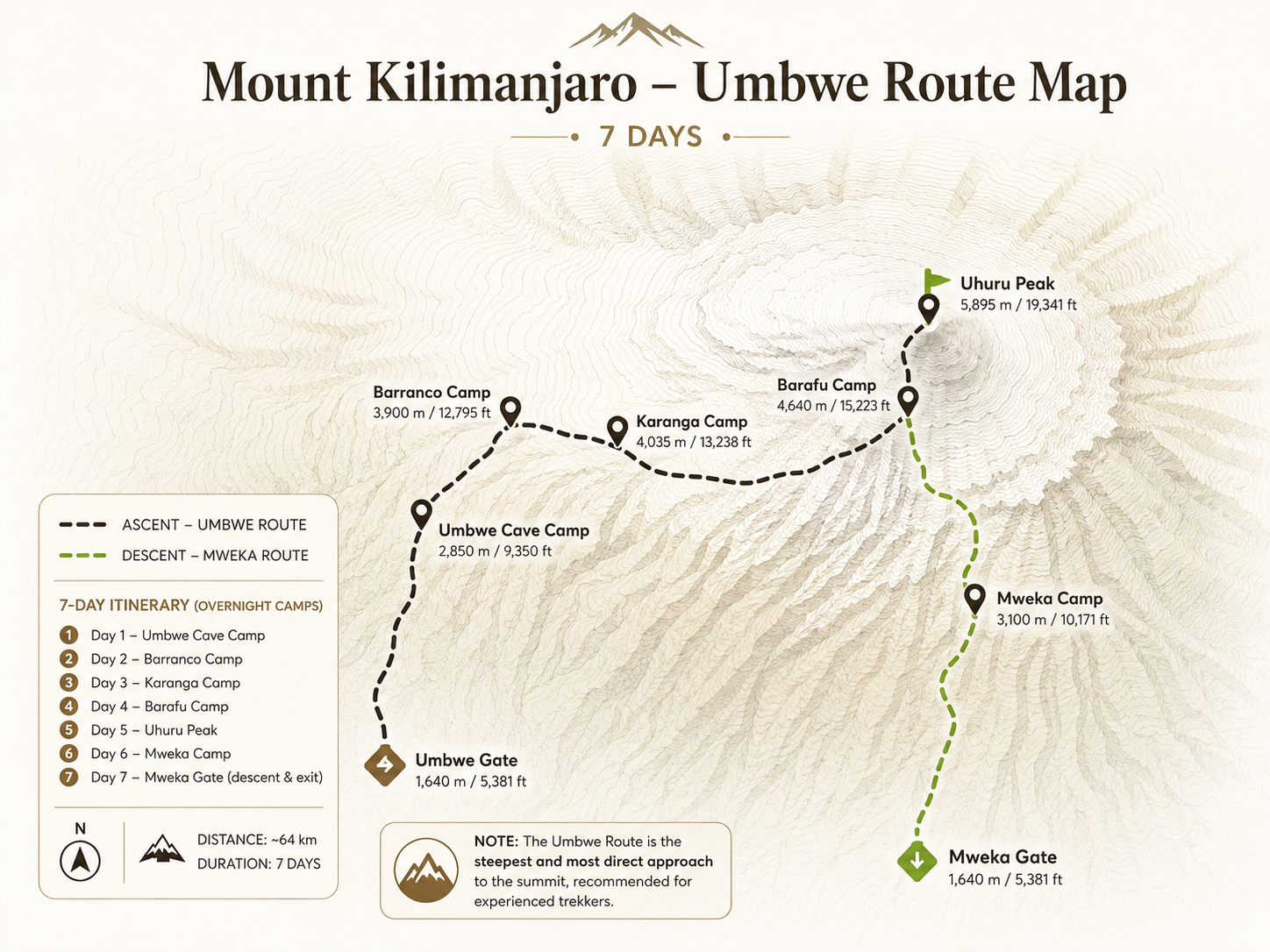
Visual Guide
Elevation Profile
5-Day Itinerary
After the drive from Moshi and registration formalities at Machame Gate, you transfer to Umbwe Gate (1,600m) at the base of the southern face. A quiet, unassuming trailhead with almost no other trekkers present. This is the Umbwe's defining character from step one: solitude. The trail enters the rainforest immediately and wastes no time on gradual approaches. It drives straight upward on a steep, narrow ridge between the Lonzo and Umbwe rivers, gaining altitude relentlessly.
The forest is dense and beautiful. Giant ferns, towering trees, mosses hanging thick from every branch. The trail is ancient-feeling and intimate, completely unlike the wider, busier paths of Machame or Lemosho. The steepness demands full attention and a consistent pace. After 5-7 hours of determined climbing, you reach Umbwe Cave Camp (2,850m). A natural cave shelter and camp site in a small clearing near the top of the forest zone. The altitude and exertion are already making themselves felt. Eat fully, drink plenty of water and rest as much as you can. Tomorrow is even more demanding.
Today the rainforest gives way to something stranger and more spectacular: the Senecio Forest. Here, giant groundsels (senecios), prehistoric-looking tree plants unique to East African mountains, rise from the moorland like ancient sentinels, their enormous rosettes pointing skyward. The vegetation is otherworldly, unlike anything on other Kilimanjaro routes at this stage. The path climbs steadily through the heather and moorland zone before descending slightly into Barranco Valley.
You arrive at Barranco Camp (3,950m), dramatically positioned beneath the sheer face of the Great Barranco Wall, with the Heim, Kersten and Decken Glaciers visible on the slopes above. This is where the Umbwe route joins the Southern Circuit and the Machame Route. On the 5-day option, you push to Barafu tomorrow without stopping at Karanga. Prepare your body. Eat well, hydrate aggressively and respect the altitude.
This is the most physically demanding day of the 5-day route. You begin with the Barranco Wall, a 257-metre non-technical scramble up the face of the volcanic cliff that forms the southern wall of Barranco Valley. Despite its fearsome appearance, the Wall uses good hand and foot holds on solid rock and your guides position themselves above to assist. The ascent takes 1-2 hours and rewards you with extraordinary views from the top. On the 5-day, there is no stopping at Karanga.
After the Wall, the trail traverses south and east along a rolling ridge line above the Karanga Valley, crossing several steep ravines and ridges beneath the vast southern glaciers. The Karanga valley junction appears but you push through without camping. The trail climbs steadily through the high alpine desert to Barafu Camp (4,600m), arriving in the early afternoon. Barafu is harsh, wind-exposed and cold. The altitude now demands everything. Headaches are common. Eat, hydrate relentlessly and sleep as early as possible. The midnight alarm comes in just hours.
Midnight. Your guides wake you into absolute cold and darkness. You dress in every layer available, thermal, fleece, insulated jacket, down parka, balaclava, thick gloves, and step out into the night. Above you, Kilimanjaro's summit rises invisible in the darkness, cold and vast. Your headlamp's beam shows only the scree slope ahead, one step at a time.
The ascent climbs the southern crater wall via endless switchbacks. The Umbwe Route summits via Stella Point (5,756m) on the crater rim. The scree is demanding and the altitude is extreme. Pole pole. Hour after hour. Then, at dawn, after 5-7 hours, you crest the crater rim at Stella Point just as the sun rises in a blaze of gold and crimson over the African horizon. The final 30-minute walk along the crater rim to Uhuru Peak (5,895m) is emotional, exhausted and unforgettable. Africa's highest point. You've earned it.
The descent via Mweka is long and relentless on depleted legs. Brief stop at Barafu for lunch, then continue down to Mweka Camp (3,100m). The forest returns. The air grows rich. You arrive shattered, victorious, and changed.
Your final day. Every muscle protests but every breath is richer, every step closer to warm air and level ground. The descent from Mweka Camp (3,100m) through the upper forest zone is steep and sometimes muddy but gloriously alive. Birds, warmth and the smell of damp earth replacing yesterday's volcanic cold. After 3-5 hours you arrive at Mweka Gate (1,640m).
Your guides and porters gather for the traditional celebration. Songs, handshakes, laughter. Your official Kilimanjaro Summit Certificate is presented. The drive back to Moshi carries you off the mountain and into the ordinary world, which will never feel quite the same again. You climbed Kilimanjaro's hardest route, in the shortest time. That is something very few people on Earth can say.
Overnight Stops
| Camp | Altitude | Zone | Night | Notes |
|---|---|---|---|---|
| Umbwe Cave Camp (Cave Bivouac) | 2,850m | Rainforest / Moorland edge | Night 1 | Natural cave shelter; steep approach; almost no other trekkers |
| Barranco Camp | 3,950m | Moorland / Alpine | Night 2 | Joins Southern Circuit & Machame route; under Barranco Wall; southern glaciers view |
| Karanga Camp | 3,960m | Alpine Desert | Skipped on 5-day | Passed through but not camped; missing this night reduces acclimatization significantly |
| Barafu Camp | 4,600m | Arctic / Alpine Desert | Night 3 | Summit base camp; most exposed camp; midnight departure |
| Uhuru Peak | 5,895m | Summit / Arctic | N/A | Via Stella Point (5,756m); Africa's highest point |
| Mweka Camp | 3,100m | Upper Forest | Night 4 | Post-summit descent camp; forest returns; last night on mountain |
| Mweka Gate (exit) | 1,640m | Forest | N/A | Day 5; summit certificate; crew celebration; return transfer to Moshi |